

New ERC report on environmental knowledge and attitudes in Irish schools
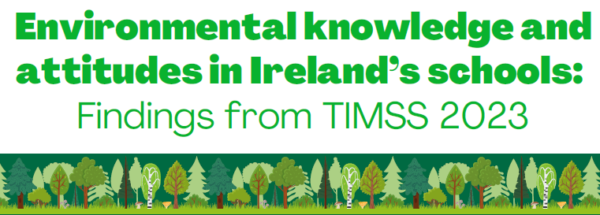
The ERC publishes today a new report: Environmental knowledge and attitudes in Ireland’s schools: Findings from TIMSS 2023.
This report presents new findings for Ireland on two aspects of students’ environmental awareness that were captured for the first time in the 2023 cycle of TIMSS (Trends in International Mathematics and Science Study):
- environmental knowledge – part of the science assessment, drawing on selected items related to environmental and climate issues, and
- attitudes towards environmental preservation.
The report presents data for Fourth Class (primary) and Second Year (post-primary) students from the TIMSS 2023 study. It also explores environmentally relevant practices and attitudes of their parents, teachers, and principals, as recorded via questionnaires.
Key findings include:
- A significant gender difference in environmental knowledge among Second Year students, but not at Fourth Class;
- More positive attitudes and practices towards environmental education in primary than in post-primary settings;
- A need expressed by both primary and post-primary teachers of science for dedicated professional learning related to the teaching of environmentalism and sustainability.
The findings, which are novel in an Irish context, are discussed with reference to the broader national policy context of environmental awareness in schools.
The report is authored by Aidan Clerkin, George Piccio, Sylvia Denner, Vasiliki Pitsia and Gráinne McHugh.
It can be downloaded here, with an infographic summary here.
The National Assessments of Mathematics and English Reading and 2021: Context Report
The 2021 National Assessments of English Reading and Mathematics (NAMER) Context Report offers a comprehensive analysis of the factors influencing achievement in Second class English reading and Sixth class maths in Ireland. Due to pandemic-related disruptions, NAMER 2021 was postponed from 2020 and adapted to reduce the testing burden. Pupils had experienced approximately two months of remote teaching prior to returning to face-to-face instruction in March 2021.
Drawing on data from questionnaires administered to pupils, teachers, and school principals, this report situates performance outcomes within broader educational and socio-economic settings. Key variables examined include, pupil background, language, instructional time and homework, teacher professional development, digital practices in school and home, and school factors such as school gender, planning and COVID-19 impact.
Recommendations stress the need to build on existing good practice in schools as well as the strengthening initiatives to improve liking and confidence in reading and mathematics.
The National Assessments of Mathematics and English Reading and 2021: Context Report
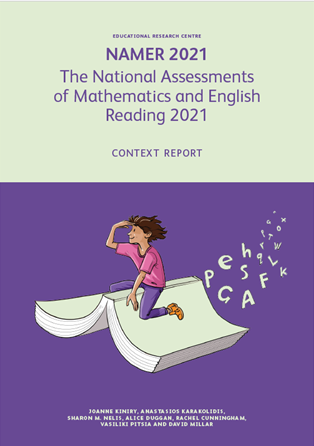
DOI: https://doi.org/10.70092/1413183.0325
Authors: Joanne Kiniry, Anastasios Karakolidis, Sharon M. Nelis, Alice Duggan, Rachel Cunningham, Vasiliki Pitsia and David Millar
Title: The National Assessments of Mathematics and English Reading and 2021: Context Report
Abstract:
The 2021 National Assessments of English Reading and Mathematics (NAMER) Context Report offers a comprehensive analysis of the factors influencing achievement in Second class English reading and Sixth class maths in Ireland. Due to pandemic-related disruptions, NAMER 2021 was postponed from 2020 and adapted to reduce the testing burden. Pupils had experienced approximately two months of remote teaching prior to returning to face-to-face instruction in March 2021.
Drawing on data from questionnaires administered to pupils, teachers, and school principals, this report situates performance outcomes within broader educational and socio-economic settings. Key variables examined include, pupil background, language, instructional time and homework, teacher professional development, digital practices in school and home, and school factors such as school gender, planning and COVID-19 impact.
Recommendations stress the need to build on existing good practice in schools as well as the strengthening initiatives to improve liking and confidence in reading and mathematics.
Publication date: 25th April 2025
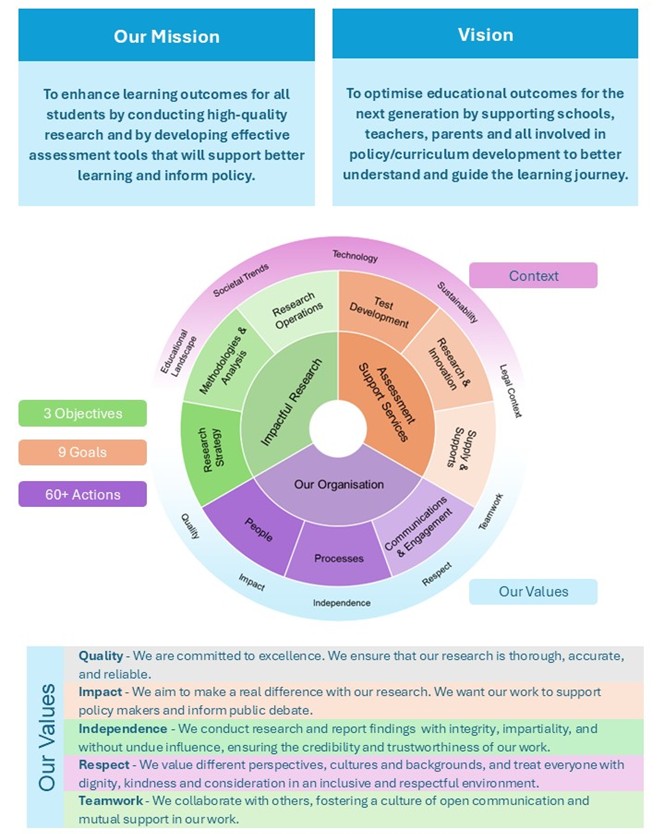
ERC publishes Strategic Plan for 2025-2030

The ERC has published its Strategic Plan for 2025-2030, a blueprint that will guide the organisation through the next phase of growth, innovation, and impact in the fields of education and research in Ireland. This plan builds on the ERC’s almost 60-year history of producing evidence-based research insights and high-quality assessment support services that facilitate the improvement of educational practices and policies.
This strategic plan outlines a vision to not only sustain but to elevate the role of the ERC. We aim to do more, engage further, and strengthen the impact of our work. Our five-year goals are ambitious, and rightly so. They are designed to position the ERC as a leader in educational research, while comprehensively supporting Ireland’s educational community with actionable insights and innovative assessment support services.
The strategic plan is the result of wide consultation with educators, researchers, policymakers, and learners, and reflects the ERC’s evolving role as a national leader in educational evidence and evaluation.
The full plan is now available here: English Version and Irish Version (FTO Plean Straitéiseach_2025-2030)

ERC publishes Strategic Plan for 2025-2030
The ERC has published its Strategic Plan for 2025-2030, a blueprint that will guide the organisation through the next phase of growth, innovation, and impact in the fields of education and research in Ireland. This plan builds on the ERC’s almost 60-year history of producing evidence-based research insights and high-quality assessment support services that facilitate the improvement of educational practices and policies.
This strategic plan outlines a vision to not only sustain but to elevate the role of the ERC. We aim to do more, engage further, and strengthen the impact of our work. Our five-year goals are ambitious, and rightly so. They are designed to position the ERC as a leader in educational research, while comprehensively supporting Ireland’s educational community with actionable insights and innovative assessment support services.
The strategic plan is the result of wide consultation with educators, researchers, policymakers, and learners, and reflects the ERC’s evolving role as a national leader in educational evidence and evaluation.
Eolas ón ERC – April 2025 Newsletter
You can read the ERC’s April 2025 Newsletter here.
This newsletter includes information on:
- The ERC Drumcondra Tests
- The benefits of online testing via DOTS
- ERC’s redevelopment of its Irish langauge tests
- Exemptions and Reasonable Accommodations
ERC commences development of new versions of Drumcondra Tests for Irish Language

The ERC is pleased to announce that we have commenced the redevelopment of our two primary-level Irish language standardised tests, which are used in Irish-medium and English-medium primary schools across Ireland.
The current tests (Triail Ghaeilge Dhroim Conrach do Bhunscoileanna Gaeltachta agus Lán-Ghaeilge (TGD-G) and Triail Ghaeilge Dhroim Conrach do Scoileanna Rialta (TGD-R)), which have been a cornerstone of language assessment of students for the past 15 years, are being comprehensively reviewed and renormed to better reflect current educational needs and practices, and up-to-date standards of Irish among children nationally. The current versions of TGD-G and TGD-R continue to provide a valuable tool for assessing Irish in schools.
The redevelopment of these standardised tests over the coming three years marks a significant step in ensuring that language assessment tools remain accurate, effective and relevant. The existing tests, which have provided invaluable data to support language learning and teaching, will be thoroughly reviewed and modernised. This process will involve collaboration with language experts, educators, and other stakeholders to ensure that the new assessments meet the highest standards of validity and reliability.
The ERC recognise the importance of providing up-to-date and robust assessment tools that reflect the evolving landscape of language education. The redevelopment of these Irish language tests will support schools in effectively evaluating language proficiency and guiding language instruction.
The new tests will aim to accommodate diverse learning contexts and will be designed to better align with current curricular objectives and linguistic research, fostering a more comprehensive understanding of students’ language abilities. Both paper and online versions of the tests will be developed by the ERC.
The ERC remains committed to supporting Irish language education through ongoing research and innovation. Further updates on the redevelopment process will be shared as the project progresses.
ERC commences development of new versions of Drumcondra Tests for Irish Language

The ERC is pleased to announce that we have commenced the redevelopment of our two primary-level Irish language standardised tests, which are used in Irish-medium and English-medium primary schools across Ireland.
The current tests (Triail Ghaeilge Dhroim Conrach do Bhunscoileanna Gaeltachta agus Lán-Ghaeilge (TGD-G) and Triail Ghaeilge Dhroim Conrach do Scoileanna Rialta (TGD-R)), which have been a cornerstone of language assessment of students for the past 15 years, are being comprehensively reviewed and renormed to better reflect current educational needs and practices, and up-to-date standards of Irish among children nationally. The current versions of TGD-G and TGD-R continue to provide a valuable tool for assessing Irish in schools.
The redevelopment of these standardised tests over the coming three years marks a significant step in ensuring that language assessment tools remain accurate, effective and relevant. The existing tests, which have provided invaluable data to support language learning and teaching, will be thoroughly reviewed and modernised. This process will involve collaboration with language experts, educators, and other stakeholders to ensure that the new assessments meet the highest standards of validity and reliability.
The ERC recognise the importance of providing up-to-date and robust assessment tools that reflect the evolving landscape of language education. The redevelopment of these Irish language tests will support schools in effectively evaluating language proficiency and guiding language instruction.
The new tests will aim to accommodate diverse learning contexts and will be designed to better align with current curricular objectives and linguistic research, fostering a more comprehensive understanding of students’ language abilities. Both paper and online versions of the tests will be developed by the ERC.
The ERC remains committed to supporting Irish language education through ongoing research and innovation. Further updates on the redevelopment process will be shared as the project progresses.
PISA 2025 – Message to schools & teachers

The ERC is grateful to schools for their participation and support in helping us administer PISA in schools in Ireland. Over 8,000 students from 172 post-primary schools will take part in PISA over the next 6 weeks. PISA is a skills based assessment that informs us how well equipped students are for life after school.
Táimid an-bhuíoch de scoileanna as a rannpháirtíocht agus as a dtacaíocht i PISA a riar. Tá níos mó ná 8,000 scoláirí ó 172 scoil ar fud na hÉireann ag glacadh páirte i PISA. Déanann PISA measúnú ar mhéid an eolais agus na scileanna atá bainte amach ag scoláirí, eolas agus scileanna a mheastar a bheith riachtanach chun páirt iomlán a ghlacadh sa tsochaí.
ERC publishes PIRLS 2021: Exploring the contexts for reading of primary school pupils in Ireland
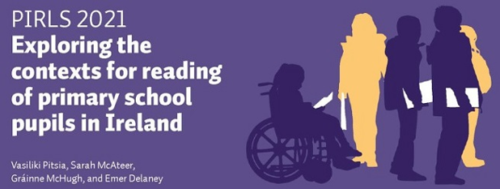
Title: PIRLS 2021: Exploring the contexts for reading of primary school pupils in Ireland
This report presents a detailed examination of reading literacy among primary school pupils in Ireland, focusing on the relationships of a wide range of contextual factors with pupils’ reading achievement. Drawing on data from the 2021 cycle of the Progress in International Reading Literacy Study (PIRLS), it delves into the demographic backgrounds and home environments of pupils, as well as their wellbeing, reading behaviours and attitudes, and digital attitudes. The report also explores the characteristics of teachers, their instructional approaches, the challenges they encounter in reading instruction, including challenges related to remote teaching and learning during the COVID-19 pandemic, and the composition, resources, and climate of schools. Key trends and international comparisons are presented, offering a global perspective on Ireland’s educational standing.
The findings are interpreted in light of national education policies and initiatives, particularly the National Strategy to Improve Literacy and Numeracy (2011-2020), and consider the profound impact of the COVID-19 pandemic on education. By identifying critical factors associated with reading achievement, the report provides essential insights into future policy directions and educational practices necessary to support and enhance literacy development in Ireland. It emphasises the importance of addressing inequalities in achievement, ensuring equitable access to educational resources, and adapting to the evolving needs of pupils in a post-pandemic educational environment.
The report is now available for download here and an infographic summary is available here.
Authors: Vasiliki Pitsia, Sarah McAteer, Gráinne McHugh, & Emer Delaney
Publication date: December 12th 2024
ERC launches the TIMSS 2023 national report

The ERC is pleased to publish the results for Ireland from TIMSS 2023 in a new report: TIMSS 2023: Insights into mathematics and science achievement in Ireland (https://doi.org/10.70092/2009137.1224).
TIMSS assesses the mathematical and scientific knowledge and skills of students in Fourth Grade and Eighth Grade (Fourth Class and Second Year in Ireland). TIMSS 2023 is the eighth cycle of the study and included 656,360 students from 65 countries.
This national report focuses on trends in overall achievement in Ireland, as well as the distribution of achievement (performance at various percentiles), student performance at the TIMSS International Benchmarks, relative strengths and weaknesses on the TIMSS content and cognitive domains, and teachers’ reports of curriculum coverage.
Performance in Ireland is explored in the context of selected countries; compared with previous cycles of TIMSS where data are available (since 2011 for Fourth Class and since 2015 for Second Year); and, where applicable, examined by gender and by socioeconomic status at both individual level and at school level (DEIS status).
Some key findings from the report include:
- The mean achievement of mathematics and science at both Fourth Class and Second Year is similar to 2015 and 2019, indicating stability in mathematics and science achievement since 2015.
- There were no significant differences in the achievement of boys and girls at Fourth Class, while boys significantly outperformed girls in mathematics and science at Second Year.
- At primary level, pupils in DEIS Urban Band 1 and Urban Band 2 schools had significantly lower mean mathematics and science achievement than pupils in non-DEIS schools. Similarly, at post-primary level, pupils in DEIS schools had significantly lower mean mathematics and science achievement than students in non-DEIS schools.
The full report can be accessed here: https://doi.org/10.70092/2009137.1224
Summary infographics are available here.
TIMSS 2023 national report will launch at 9am Wednesday 4th December
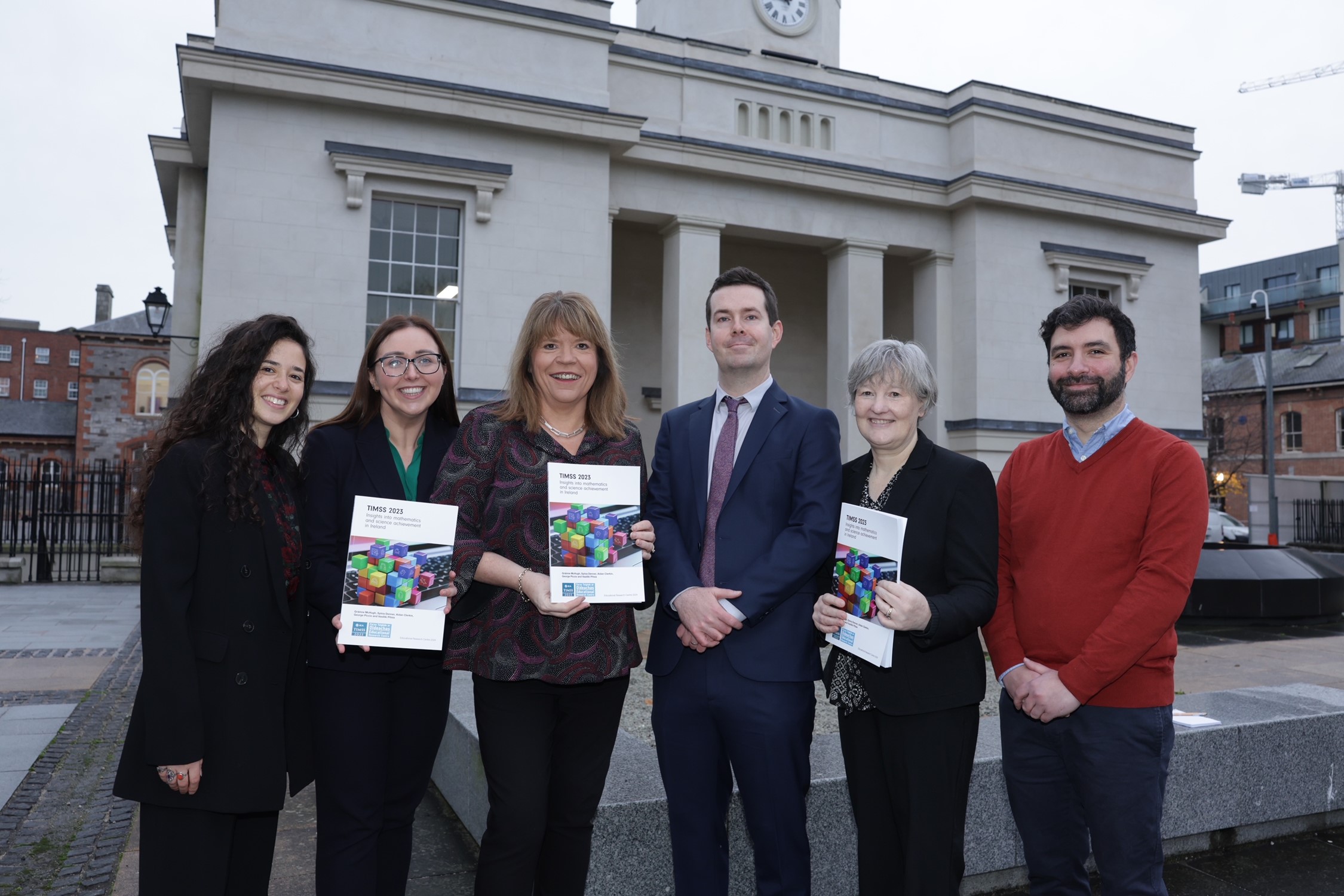
The ERC is pleased to announce the forthcoming launch of the TIMSS 2023 national report which will be available from https://doi.org/10.70092/2009137.1224 at 9am on Wednesday 4th December 2024.
TIMSS (Trends in International Mathematics and Science Study) has been assessing the mathematics and science skills of Fourth Grade and Eighth Grade students internationally (Fourth Class and Second Year in Ireland) since 1995, serving as a valuable tool for monitoring trends in mathematics and science achievement. It also collects contextual information from students, parents/guardians, teachers and school principals.
TIMSS 2023 is the eighth cycle of the study which started in 1995, providing almost 30 years of trend data. TIMSS 2023 was administered in 65 countries (including Ireland) and includes over 650,000 students worldwide. In Ireland, 360 schools and almost 13,000 students took part in TIMSS 2023.
TIMSS 2023 marks Ireland’s transition to digital testing. A national mode effect study was also included to monitor how student achievement may be affected by the mode of assessment (paper vs digital).
The TIMSS 2023 report will be accessible at: https://doi.org/10.70092/2009137.1224.
ERC launches a new report on students’ experience of P-TECH Ireland

The ERC is pleased to announce the release of our latest report: P-TECH Student Survey Report 2024. This report focuses on the experience of the first cohort of P-TECH students in Ireland as they complete post-primary school. The report is now available for download here: https://doi.org/10.70092/1620538.0924
ERC launches final report of the longitudinal Digital Learning Framework Evaluation

The ERC is pleased to publish the final report of the longitudinal Digital Learning Framework Evaluation. It evaluates the implementation of the DLF from multiple perspectives over a three-year period. The report examines the current policy and research landscape on the use of digital technologies in schools and considers how schools have had successes and met challenges in their embedding and implementation of the DLF.
For more, read the report here.
ERC launches a new report on DEIS action planning for school improvement
The ERC is pleased to announce the release of our latest report: Principals’ initial perspectives of action planning in new DEIS primary and post-primary schools. This report focuses on action planning implementation in schools entering DEIS for the first time in 2022. We encourage all stakeholders in the DEIS community to read this resource!
The report is now available for download here and an infographic summary is available here.
TIMSS 2019 Report published by the ERC
The ERC has published a follow-up report drawing on TIMSS 2019 data which explores the areas in mathematics and science where students in Ireland perform particularly strongly as well as the areas where they do less well. The report can be downloaded here and Appendix Tables here.
The Trends in International Mathematics and Science Study (TIMSS) is a project of the International Association for the Evaluation of Educational Achievement (IEA). TIMSS assesses the mathematics and science achievement of students in the Fourth and/or Eighth grades (equivalent to Fourth Class and Second Year in Ireland). The study also collects detailed information about curriculum and curriculum implementation, instructional practices, and school resources.
Call for Inputs – Glaonna d’ionchuir
The ERC is calling for inputs to gather the views of stakeholders on how the role of the ERC may evolve over the coming period and what strategic priorities should be included in our forthcoming Strategy.
The ERC’s forthcoming Strategy will cover the five years from 2025 to 2030.
The aim of this Call for Inputs is to gather the views of stakeholders on how the role of the ERC may evolve over the coming period and what strategic priorities should be included in our forthcoming Strategy. For example, how will the education and research sectors adapt to a changing context, or similarly, how might these sectors be impacted by significant trends and developments in areas such as digital adoption, the literacy and numeracy attainment of students, the challenges presented by climate change and more generally, changing behaviours and attitudes of schools, parents and students.
Click here for more information.
Tá an FTO ag lorg ionchuir chun tuairimí na leaspháirtithe a fháil, maidir le conas a fhorbróidh ról an FTO sa tréimhse atá le teacht agus cad iad na tosaíochtaí straitéiseacha gur chóir a bheith san áireamh sa Straitéis atá le teacht uain
Clúdóidh Straitéis an FTO atá le teacht na cúig bliana ó 2025 go 2030.
Tá sé mar aidhm ag an nGlao ar Ionchuir seo tuairimí na bpáirtithe leasmhara a bhailiú faoin éabhlóid a d’fhéadfadh teacht ar ról an FTO sa tréimhse amach romhainn agus na tosaíochtaí straitéiseacha ar cheart a chur san áireamh sa Straitéis atá le teacht uainn go luath. Mar shampla, conas a rachaidh na hearnálacha oideachais agus taighde in oiriúint ar chomhthéacs athraitheach. Ar an dóigh chéanna, cén éifeacht a d’fhéadfadh a bheith ag treochtaí suntasacha agus forbairtí ar na hearnálacha seo i réimsí lena n-áirítear glacadh digiteach, gnóthachtáil litearthachta agus uimhearthachta na ndaltaí agus na dúshláin a thagann le hathrú aeráide. Ar bhonn níos ginearálta, athruithe iompair agus meoin i measc scoileanna, tuismitheoirí agus daltaí.
Déan cliceáil anseo le haghaidh breis eolais
ERC launches report on Creative Thinking in PISA 2022
The ERC has published a new report on creative thinking – Cultivating Creativity: What the PISA 2022 results say about creative thinking in Ireland. The report draws on data from the student, parent and school questionnaires from PISA 2022 and explores young people’s experience of creativity and creative thinking inside and outside of school, and within the home environment. The report can be downloaded here and the e-appendix is available here.
ERC launches a new report about home backgrounds, classrooms and schools of pupils in Urban DEIS schools
The ERC is pleased to have launched a new report – Ireland’s 2021 National Assessments of Mathematics and English Reading: Exploring the home backgrounds, classrooms and schools of pupils in Urban DEIS schools. The report draws on data from the pupil, teacher and school questionnaires from NAMER ’21 and profiles the homes, classrooms, and schools of participating pupils in Urban DEIS schools. The report can be downloaded here and an infographic summary is available here.