PISA 2025: Ireland’s 15-year-olds demonstrate strong educational performance, despite declines in reading and mathematics

Key points

The Programme for International Student Assessment (PISA) is the largest educational study in the world. It assesses 15-year-olds in the domains of science, reading, mathematics, and learning in the digital world (computational problem solving).

Overall performance and trend patterns

  • Students in Ireland outperformed their counterparts in most other participating countries across all four domains.
  • Ireland’s performance was above the OECD and EU averages in all domains.
  • Ireland’s science performance, as well as average science performance across OECD and EU countries, remained relatively stable compared to previous cycles.
  • Ireland’s average performance in reading and mathematics declined compared to previous cycles. Declines were also observed at the OECD and EU levels.

Low- and top-performing students

  • There were considerably lower proportions of low performers (i.e. students lacking key skills and competences) in Ireland across all domains compared to the average across OECD and EU countries.
  • Ireland did not have as high a proportion of top performers (i.e. students with advanced competencies) as might be expected given its strong overall performance.

Gender

  • In Ireland, boys outperformed girls on average in science, mathematics, and computational problem solving, while girls outperformed boys in reading.

Immigration status

  • Second-generation immigrants (i.e. students born in Ireland to immigrant parents) demonstrated strong performance across all domains. In mathematics and computational problem solving, this group significantly outperformed their peers.
  • First-generation immigrants (i.e. students born outside Ireland to immigrant parents) had the lowest performance across all domains, except for computational problem solving, where they performed better than non-immigrant students.

Grade levels and school types

  • Students in Transition Year performed better than those in other grade levels.
  • Students in secondary schools and those in non-DEIS schools performed better, on average, than their peers in other school types.

Overall performance in science, reading, mathematics, and computational problem solving

Science was the major domain in PISA 2025, with students in Ireland achieving a mean science score (500 points) that was above both the OECD (482 points) and EU (476 points) averages. Overall science performance in Ireland and across the OECD on average remained relatively stable compared to recent PISA cycles. A pattern of small declines was observed at the EU level, where the average science score in 2025 was lower than those achieved in 2015 and 2018.

In PISA 2025, students in Ireland achieved mean reading (500 points) and mathematics (480 points) scores that were above the corresponding OECD (reading: 461 points, mathematics: 463 points) and EU (reading: 451 points, mathematics: 460 points) averages. However, a significant decline in reading and mathematics performance was observed in Ireland in 2025 compared to previous cycles. Similar declines were observed between 2022 and 2025 across the OECD and the EU, on average, while over the longer term, the OECD and the EU saw larger drops than Ireland in their average reading and mathematics performance.

In PISA 2025, student performance in computational problem solving was assessed as part of the innovative domain of learning in the digital world. This domain was assessed only in 2025, measuring students’ ability to learn, adapt, and solve problems using new digital tools in unfamiliar environments. Students in Ireland achieved a mean score in computational problem solving (511 points) that was above the OECD (500 points) and EU (492 points) averages.


Low- and top-performing students

Across all domains assessed, Ireland had lower proportions of low performers (science: 17.6%, reading: 16.5%, mathematics: 24.2%) compared to the OECD (science: 25.7%, reading: 31.0%, mathematics: 34.9%) and EU (science: 27.3%, reading: 33.9%, mathematics: 34.8%) averages. On the other hand, despite the fact that Ireland performed above the OECD and EU averages across all domains, the proportion of top performers in mathematics (6.1%) was lower than the OECD average (7.8%) and similar to the EU average (6.7%). In science, the proportion of top performers in Ireland (7.4%) was above the EU average (6.1%) but similar to the OECD average (7.2%). Reading was the only domain in which the proportion of top-performing students was higher in Ireland (8.5%) than in the OECD (5.5%) and EU (4.2%). These patterns are broadly consistent with those observed in previous cycles.

Performance differences by gender

Gender differences in performance were observed across all domains in Ireland, as well as on average across OECD and EU countries. In Ireland, boys performed on average better than girls in science (difference of 7 points); this is in contrast to the patterns observed at the OECD and EU levels, where the gender differences were in favour of girls. Boys in Ireland also achieved higher mean scores than girls in mathematics and computational problem solving (difference of 17 points in mathematics and 16 points in computational problem solving); similar patterns were observed at the OECD and the EU on average. Girls outperformed boys in reading in Ireland (by 19 points), as well as on average across OECD and EU countries. Both boys and girls attending single-sex schools had higher mean scores across all four domains than their counterparts in mixed schools.

Performance differences by immigration status

The proportion of students with an immigrant background taking part in PISA in Ireland has gradually increased over the last decade, mostly due to the increased number of second-generation immigrants; 13% of students who took part in PISA 2025 in Ireland were second-generation immigrants, and 10% were first-generation immigrants. At the OECD and EU levels, non-immigrant students outperformed, on average, both first- and second-generation immigrant students in all four domains. In Ireland, however, different patterns emerged. In science and reading, non-immigrant students had broadly similar average performance to second-generation immigrant students, but higher than first-generation immigrants (difference of 24 points in science and 35 points in reading). In mathematics, second-generation immigrant students achieved the highest mean score, outperforming both non-immigrant (by 8 points) and first-generation immigrant students (by 17 points), but non-immigrant students still performed, on average, better than their first-generation immigrant peers (difference of 9 points). In computational problem solving, non-immigrant students performed less well, on average, than both second- and first-generation immigrants (difference of 22 and 9 points, respectively).

Examining trends over time, non-immigrant students maintained stable performance in science, but their mean scores in reading and mathematics were lower in 2025 than in previous cycles. First-generation immigrant students experienced significant declines across all three domains compared with most previous cycles, with the decline in reading being particularly pronounced and substantially greater than the declines observed in the other domains and among non-immigrant students. Second-generation immigrant students, on the other hand, maintained stable performance across all three domains over time; in the case of science, this group’s performance has improved since 2018. Overall, performance trends in these three domains broadly resembled those observed for non-immigrant students.

Performance differences by grade level, school type, and DEIS status

Across all domains, students in Transition Year outperformed, on average, their peers in other grade levels (differences ranged between 15 and 38 points across domains). Students attending secondary schools performed, on average, better than those attending ETB or community/comprehensive schools (differences ranged between 14 and 35 points across domains). Finally, students in DEIS schools had lower mean scores than their peers in non-DEIS schools (differences ranged between 30 and 53 points across domains).


Further information

What is PISA?

PISA is the world’s largest educational study. It is a project of the Organisation for Economic Co-operation and Development (OECD) that examines the knowledge and skills of 15-year-old students in science, reading, mathematics, and an innovative domain that changes with each cycle. In PISA 2025, learning in the digital world was the innovative domain, assessing computational problem solving (i.e. students’ ability to learn, adapt, and solve problems using new digital tools in unfamiliar environments).

How is PISA administered?

Since 2015, PISA has been administered as a computer-based assessment in the majority of participating countries, including all OECD countries. In 2025, PISA was administered in 91 countries and economies across the world, with over 760,000 students completing the assessment. In Ireland, a representative sample of 6,356 15-year-olds from 172 schools took part between March and April 2025 (most students attended Third Year and Transition Year, with a small proportion in other grade levels). In Ireland, PISA is implemented by the Educational Research Centre (ERC) on behalf of the Department of Education and Youth. In 2025, PISA was administered in schools by inspectors from the Department of Education and Youth, alongside support test administrators, technical support personnel, and ERC representatives. To ensure internationally consistent administration, external quality monitors were contracted by the PISA consortium to monitor testing procedures in schools in all countries/economies, including Ireland.

Reports

The national PISA 2025 report (authored by Karakolidis, A., Duggan, B., Keating, A., & Toole, N.) can be accessed here.

The international PISA 2025 report can be accessed here.

Contacts

Dr Anastasios Karakolidis, PISA 2025 National Project Manager; anastasios.karakolidis@erc.ie;  National PISA team; PISA.Ireland@erc.ie
New article in Volume 51 of the Irish Journal of Education

📢 New article in Volume 51 of the Irish Journal of Education!

Sarah McAteer from the Research Centre analyses data from PIRLS 2021and TIMSS 2023 focusing on the home learning environment and parental characteristics of high- and low-achieving pupils in Ireland.

Read the article here: https://doi.org/10.70092/IJE.51.01

📝 We welcome submissions for future volumes. Submission guidelines and templates are available at https://www.erc.ie/irish-journal-of-education/notes-to-contributors/

📧 For any queries, please contact ije@erc.ie


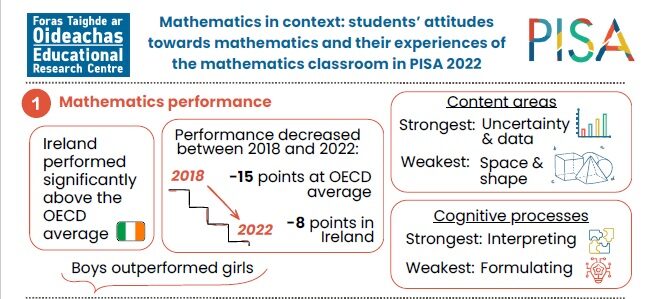
ERC report examines students’ attitudes towards mathematics and their experiences of the mathematics classroom

Mathematics in context: students’ attitudes towards mathematics and their experiences of the mathematics classroom in PISA 2022

Authors: Brendan O’Neill, Aidan Clerkin, Rachel Perkins, Kervin Soobrayen


This report describes students’ experiences of mathematics in Ireland, their feelings towards the subject, and also trends in mathematics performance, both overall and across different content areas and cognitive processes. Drawing on data from the 2022 cycle of Programme for International Student Assessment (PISA), collected from 15-year-old students and their school principals, various aspects related to the teaching and learning of mathematics are examined and compared with international averages for the OECD and the EU. The composition of the mathematics classroom, and the role of digital technologies, are examined along with the disciplinary climate in the mathematics classroom. Student perceptions of various teaching behaviours and their own learning strategies are explored. The report goes on to look at students’ familiarity with and exposure to various aspects of mathematics, their attitudes towards mathematics and the extent of confidence and anxiety associated with mathematics, concluding with a discussion of the key themes that emerge from the data.
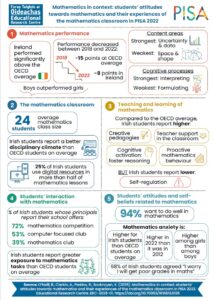

The report can be accessed here: https://doi.org/10.70092/1691813.0126

Infographic


Gairm ar Chomhairliúchán: Ábhar Trialach Luathlitearthachta agus Luathuimhearthachta – Gaeilge

Tá an Foras Taighde ar Oideachas (FTO) ag athfhorbairt na trialacha luathlitearthachta agus luathuimhearthachta (TLLDC/TLUDC), a úsáidtear ag deireadh na Naíonán Mór (NM) agus/nó ag tús Rang a hAon (R1). Is iad na cuspóirí atá ag na trialacha seo ná leanaí, ar dócha go bhfuil baol ann go bhfuil deacrachtaí litearthachta agus/nó uimhearthachta acu, a aithint (ag baint úsáid as leabhrán trialach a riartar i ngrúpaí ar dtús) agus na gnéithe áirithe litearthachta/uimhearthachta a chruthaíonn dúshláin ar leith a phróifíliú (ag baint úsáid as measúnú indibhidiúil a thagann ina dhiaidh).

Is é seo an chéad uair riamh atá trialacha luathlitearthachta agus luathuimhearthachta á bhforbairt as Gaeilge ar mhaithe le páistí i ngach cineál oideachais trí mheán na Gaeilge a mheasúnú. Ba mhaith leis an FTO cuireadh a thabhairt do mhúinteoirí bunscoile feidhmiú mar shaineolaithe teanga agus comhairle a thabhairt ar an ábhar don Triail Bhailíochtaithe a bheidh i gceist do na trialacha seo i 2026/2027. Déanfar an comhairliúchán seo ar bhonn deonach. Is deis í seo do mhúinteoirí a bhfuil taithí mhúinteoireachta acu i nGaelscoileanna agus i scoileanna Gaeltachta agus a bhfuil suim áirithe acu san oideachas litearthachta agus uimhearthachta trí mheán na Gaeilge. Ba mhaith leis an FTO iarrthóirí a fháil ó chineálacha éagsúla scoileanna ar fud na tíre (m.sh., Gaelscoileanna agus scoileanna Gaeltachta, scoileanna DEIS agus scoileanna nach scoileanna DEIS iad, scoileanna measctha agus scoileanna aonghnéis) le cinntiú go dtagann an t-aiseolas ó réimse leathan comhthéacsanna.

Cuirfear ceist ort athbhreithniú a dhéanamh ar an ábhar luathlitearthachta agus luathuimhearthachta don Triail Bhailíochtaithe agus an leibhéal deacrachta agus oiriúnachta don aoisghrúpa cuí a mheas sula nglacfaidh tú páirt sa seisiúin comhairliúcháin. Glacfaidh tú páirt ansin i gcruinniú, a mhairfidh 2 uair an chloig, le taighdeoirí de chuid an FTO leis an ábhar trialach a phlé agus le comhairle nó moltaí ar bith a roinnt. Ba chóir go mbeadh iarrthóirí ar an eolas go ndéanfar taifead ar an gcruinniú seo, ar mhaithe le taifead sonraí, agus go gcuirfidh muid ceist ar bhaill an chruinnithe na ceamaraí a chur ar siúl, ar mhaithe le plé a éascú.

Tabhair faoi deara, le do thoil: Mar gheall ar an gcineál gníomhaíochta a bheidh i gceist, roghnófar líon teoranta iarrthóirí ionas go mbeidh plé dírithe agus torthúil againn. Roghnófar iarrthóirí incháilithe ionas go mbeidh ionadaíocht leathan ann ó réimsí éagsúla suntasacha i.e., taithí/blianta caite ag múineadh,  róil mhúinteoireachta, cineálacha scoileanna agus canúintí.

Déanfar an t-aiseolas ón seisiún comhairliúcháin a anaithnidiú – ní scaoilfí/scaipfí le heolas inaitheanta pearsanta ar bith amach anseo agus ní bheifí in ann sainaithint a dhéanamh ort ón méid a chuirfeá leis an gcomhairliúchán. .Úsáidfear do chuid aiseolais le míreanna trialacha a leasú, a roghnú agus a bhaint ón triail. Tá seans ann go n-úsáidfear agus go scaipfear an t-aiseolas amach anseo, mar chur i láthair comhdhála, alt irise piarmheasúnaithe srl.

Critéir Cháilitheachta

  • Gaeilge líofa
  • Taithí ag múineadh NM/R1 nó mar MOS trí mheán na Gaeilge (i nGaelscoil nó i scoil Ghaeltachta)
  • Suim sa luathlitearthacht agus/nó sa luathuimhearthacht
  • Fáil ort idir an 30 Márta agus 2 Aibreán le freastal ar chruinniú ar líne le taighdeoirí de chuid an FTO

Riachtanais an Iarratais

  • Foirm iarratais chomhlánaithe

‘Spriocdháta don Iarratas: 5:00i.n. 13ú Márta

Modh Iarratais: Comhlánaigh an fhoirm iarratais ag an nasc seo.

Cuireann muid fáilte roimh spéis ó iarrthóirí tiomanta agus cáilithe agus tá muid ag súil go mór le d’ iarratas a fháil. Má tá ceisteanna nó ábhar imní ar bith agat, is féidir ríomhphost a sheoladh chuig earlylitnum@erc.ie.


Le gach dea-ghuí,

Foras Taighde ar Oideachas

PODCAST: Standardised Testing in Irish Education

NTO’s Máirín Máirín Ní Chéileachair as part of its Teacher Talk podcast to talk about about how standardised tests are created, setting accurate norms and the vital partnership with schools that makes this possible and why they must be regularly revised to stay aligned with curriculum changes.
Listen to the podcast here.

ERC@60 Conference

Date: 29th January 2026

Location: Gresham Hotel, Dublin 1

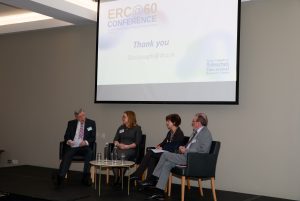
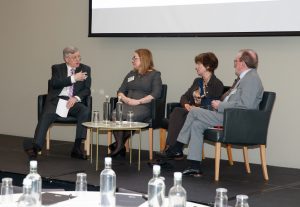
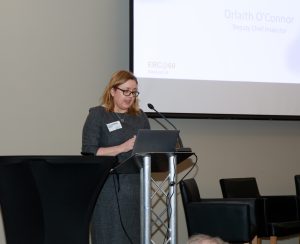
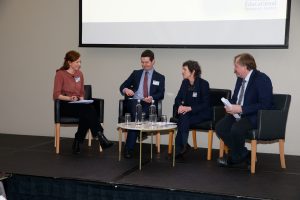
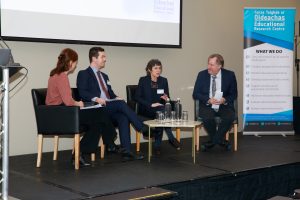
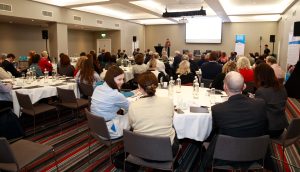
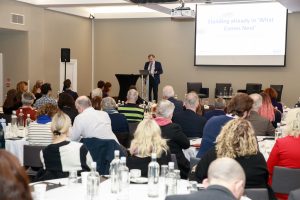
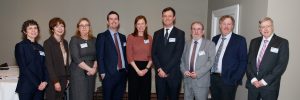
The ERC@60 Conference brought together researchers, educators, policymakers and partners to celebrate six decades of educational research and impact. Marking the 60th anniversary of the Educational Research Centre, the event provided a platform to reflect on the Centre’s contributions to education research, assessment and policy in Ireland and beyond, and to look ahead to emerging priorities.

The programme featured keynote talks, panel discussions and presentations highlighting key research themes, lessons learned over the years, and future directions for evidence-informed practice and policy. Delegates engaged in rich discussion about evolving challenges in education and the role of research in supporting effective solutions. The conference was an opportunity not only to honour the ERC’s history but also to strengthen connections across the education and research community as we enter the next decade of work.

Speakers included: Prof Eugene Wall, Dr Peter Archer, Orlaith O’Connor (DEY), Prof Zita Lysaght (DCU), Prof Christian Christrup Kjeldsen (IEA), Dr Jude Cosgrove (EC JRC) and Aidan Clerkin (ERC).

📋Agenda:

  • 8.30 – 9.30: Registration (with Tea/Coffee)
  • 9.30 – 9.50: Introduction and Address by Chairperson of the ERC
  • 9.50 – 11.00: Session 1: A reflection on 60 years of the ERC
  • 11.00 – 11.30: Tea/coffee break
  • 11.30 – 12.45: Session 2: Looking ahead: Perspectives on the future of educational research
  • 12.45 – 13.00: Concluding remarks
  • 13.00 – 14.00: Lunch

Photos

An chéad triail dá leithéid – Triail litearthachta iarbhunscoile as Gaeilge

An chéad triail dá leithéid – Triail litearthachta iarbhunscoile as Gaeilge

6ú Deireadh Fómhair 2025

I gcomhar leis an tSeirbhís Náisiúnta Síceolaíochta Oideachais ón Roinn Oideachais agus Óige, sheol an Foras Taighde ar Oideachas an triail ‘Measúnú agus Diagnóisic Litearthachta don Iarbhunscoil – Gaeilge’ (MDLI-G) inniu.

Is triail litearthachta Gaeilge í an triail seo, an chéad triail dá leithéid ag leibhéal na hiarbhunscoile, agus tá sé le bheith mar uirlis fhoghlama thábhachtach i scoileanna lán-Ghaeilge.

Forbraíodh an t-ábhar go sonrach don chomhthéacs Gaeilge, agus forbraíodh na noirm sna scoileanna lán-Ghaeilge le haghaidh scoláirí na chéad agus na tríú bliana. Díríonn an triail ar chúig scil litearthachta sa Ghaeilge: léamhthuiscint, mearléitheoireacht, léitheoireacht focal, scríbhneoireacht agus litriú.

Is féidir an triail a úsáid in éineacht leis an triail Béarla, PPAD-E, chun léargas cuimsitheach a ghnóthú de riachtanais litearthachta an scoláire. Tá tuilleadh eolais maidir le MDLI-G, PPAD-E agus trialacha eile ar fáil ag www.tests.erc.ie.

First of its kind – Post-Primary Literacy Test in Irish

6th October 2025

The Educational Research Centre in collaboration with the National Educational Psychological Service of the Department of Education and Youth today launched the ‘Measúnú agus Diagnóisic Litearthachta don Iarbhunscoil – Gaeilge’ (MDLI-G) test.

This test of literacy in Irish, is the first of its kind at post-primary level and is set to become a key tool for learning in Irish-medium schools.

With content specifically developed for Irish-language contexts, norms were developed in Irish-medium schools for First- and Third-Year students. The test examines five key literacy skills in Irish: reading comprehension, reading fluency, word reading, writing, and spelling.

The test can be used alongside its English-language sister test, PPAD-E, to obtain a rounded picture of a student’s literacy needs. More information on MDLI-G, PPAD-E and other ERC tests can be found at www.tests.erc.ie.

An chéad triail dá leithéid – Triail litearthachta iarbhunscoile as Gaeilge

An chéad triail dá leithéid – Triail litearthachta iarbhunscoile as Gaeilge

6ú Deireadh Fómhair 2025

I gcomhar leis an tSeirbhís Náisiúnta Síceolaíochta Oideachais ón Roinn Oideachais agus Óige, sheol an Foras Taighde ar Oideachas an triail ‘Measúnú agus Diagnóisic Litearthachta don Iarbhunscoil – Gaeilge’ (MDLI-G) inniu.

Is triail litearthachta Gaeilge í an triail seo, an chéad triail dá leithéid ag leibhéal na hiarbhunscoile, agus tá sé le bheith mar uirlis fhoghlama thábhachtach i scoileanna lán-Ghaeilge.

Forbraíodh an t-ábhar go sonrach don chomhthéacs Gaeilge, agus forbraíodh na noirm sna scoileanna lán-Ghaeilge le haghaidh scoláirí na chéad agus na tríú bliana. Díríonn an triail ar chúig scil litearthachta sa Ghaeilge: léamhthuiscint, mearléitheoireacht, léitheoireacht focal, scríbhneoireacht agus litriú.

Is féidir an triail a úsáid in éineacht leis an triail Béarla, PPAD-E, chun léargas cuimsitheach a ghnóthú de riachtanais litearthachta an scoláire. Tá tuilleadh eolais maidir le MDLI-G, PPAD-E agus trialacha eile ar fáil ag www.tests.erc.ie.

First of its kind – Post-Primary Literacy Test in Irish

6th October 2025

The Educational Research Centre in collaboration with the National Educational Psychological Service of the Department of Education and Youth today launched the ‘Measúnú agus Diagnóisic Litearthachta don Iarbhunscoil – Gaeilge’ (MDLI-G) test.

This test of literacy in Irish, is the first of its kind at post-primary level and is set to become a key tool for learning in Irish-medium schools.

With content specifically developed for Irish-language contexts, norms were developed in Irish-medium schools for First- and Third-Year students. The test examines five key literacy skills in Irish: reading comprehension, reading fluency, word reading, writing, and spelling.

The test can be used alongside its English-language sister test, PPAD-E, to obtain a rounded picture of a student’s literacy needs. More information on MDLI-G, PPAD-E and other ERC tests can be found at www.tests.erc.ie.

New ERC report on continuity and change in Ireland’s primary and post-primary schools and classrooms

The ERC is delighted to announce the publication of a new report: Continuity and change in Ireland’s schools and classrooms: TIMSS 2011-2023.

This report, drawing on TIMSS data at both primary and post-primary levels, focuses on:

  • the composition, resources, and environments of schools
  • teaching and assessment practices in mathematics and science lessons
  • challenges and opportunities shaping teaching and learning
  • differences by school gender and school DEIS status

Read the full report here

Check out the infographic here

Explore the appendices for a deeper dive into the data here


New ERC report on environmental knowledge and attitudes in Irish schools

The ERC publishes today a new report: Environmental knowledge and attitudes in Ireland’s schools: Findings from TIMSS 2023.

This report presents new findings for Ireland on two aspects of students’ environmental awareness that were captured for the first time in the 2023 cycle of TIMSS (Trends in International Mathematics and Science Study):

  • environmental knowledge – part of the science assessment, drawing on selected items related to environmental and climate issues, and
  • attitudes towards environmental preservation.

The report presents data for Fourth Class (primary) and Second Year (post-primary) students from the TIMSS 2023 study. It also explores environmentally relevant practices and attitudes of their parents, teachers, and principals, as recorded via questionnaires.

Key findings include:

  • A significant gender difference in environmental knowledge among Second Year students, but not at Fourth Class;
  • More positive attitudes and practices towards environmental education in primary than in post-primary settings;
  • A need expressed by both primary and post-primary teachers of science for dedicated professional learning related to the teaching of environmentalism and sustainability.

The findings, which are novel in an Irish context, are discussed with reference to the broader national policy context of environmental awareness in schools.

The report is authored by Aidan Clerkin, George Piccio, Sylvia Denner, Vasiliki Pitsia and Gráinne McHugh.

It can be downloaded here, with an infographic summary here.

New Data Sharing Agreements between State Examinations Commission (SEC) and the ERC

The State Examinations Commission has entered into a Data Sharing Agreement with the Educational Research Centre for DEIS and SET Allocation on 13 August 2025.

Data Sharing Agreement available here:

SECERC 025/240718


The State Examinations Commission has entered into a Data Sharing Agreement with the Educational Research Centre for Studies, Test Development, and Independent Research on 13 August 2025.

Data Sharing Agreement available here:

SECERC 026/240718

New Data Sharing Agreements between State Examinations Commission (SEC) and the ERC

The State Examinations Commission has entered into a Data Sharing Agreement with the Educational Research Centre for DEIS and SET Allocation on 13 August 2025.

Data Sharing Agreement available here.


The State Examinations Commission has entered into a Data Sharing Agreement with the Educational Research Centre for Studies, Test Development, and Independent Research on 13 August 2025.

Data Sharing Agreement available here.

New ERC report on trends in student experiences in school and attitudes to mathematics and science

The ERC publishes today a new report: Trends in students’ school experiences and attitudes towards mathematics and science: TIMSS 2015-2023.

This report presents data for Fourth Class (primary) and Second Year (post-primary) students from the TIMSS 2023 study, and identifies trends relative to previous cycles of TIMSS in 2015 and 2019). It examines the experiences of students in relation to their attendance at school, sense of belonging, and experiences of bullying. Also presented in the report are students’ attitudes towards mathematics and science; in particular, the extent to which students like learning, feel confident, and value mathematics and science.

Key findings include:

· Increasing rates of student absence from school between 2019 and 2023.

· A gradual decline between 2015 and 2023 in liking mathematics and science and confidence in mathematics and science.

· Boys liked learning mathematics and were more confident in mathematics than girls.

· At primary, boys and girls reported similar levels of confidence in science, while at post-primary boys were more confident than girls.

· At Fourth Class, more students in DEIS Urban schools very much liked learning mathematics compared to students in other schools.

The findings are discussed in the report with reference to the broader national policy context and related national and international research.

The report is authored by Sylvia Denner, Aidan Clerkin, Vasiliki Pitsia and Gráinne McHugh. It can be downloaded here, with an infographic summary here.

New ERC report on trends in student experiences in school and attitudes to mathematics and science

The ERC publishes today a new report: Trends in students’ school experiences and attitudes towards mathematics and science: TIMSS 2015-2023.

This report presents data for Fourth Class (primary) and Second Year (post-primary) students from the TIMSS 2023 study, and identifies trends relative to previous cycles of TIMSS in 2015 and 2019). It examines the experiences of students in relation to their attendance at school, sense of belonging, and experiences of bullying. Also presented in the report are students’ attitudes towards mathematics and science; in particular, the extent to which students like learning, feel confident, and value mathematics and science.

Key findings include:

  • · Increasing rates of student absence from school between 2019 and 2023.
  • · A gradual decline between 2015 and 2023 in liking mathematics and science and confidence in mathematics and science.
  • · Boys liked learning mathematics and were more confident in mathematics than girls.
  • · At primary, boys and girls reported similar levels of confidence in science, while at post-primary boys were more confident than girls.
  • · At Fourth Class, more students in DEIS Urban schools very much liked learning mathematics compared to students in other schools.

The findings are discussed in the report with reference to the broader national policy context and related national and international research.

The report is authored by Sylvia Denner, Aidan Clerkin, Vasiliki Pitsia and Gráinne McHugh. It can be downloaded here, with an infographic summary here.

How standardised testing shapes future education – the Future of Education Report

The Future of Education Report 2025 launched today, highlighting how by fostering collaboration, Ireland is building towards an inclusive and accessible lifelong-learning system.

ERC researchers Rachel Cunningham, Conall Ó Duibhir and Brenda Donohue have written an article on the role and future of standardised testing in the Irish education system.

Visit https://www.businessnews.ie/education/how-standardised-testing-shapes-future-education/ to read more #futureofeducationie2025

How standardised testing shapes future education – the Future of Education Report

The Future of Education Report 2025 launched today, highlighting how by fostering collaboration, Ireland is building towards an inclusive and accessible lifelong-learning system.

ERC researchers Rachel Cunningham, Conall Ó Duibhir and Brenda Donohue have written an article on the role and future of standardised testing in the Irish education system.

Visit https://www.businessnews.ie/education/how-standardised-testing-shapes-future-education/ to read more

ERC launches final report of the longitudinal Digital Learning Framework Evaluation

ERC launches a new report on students’ experience of P-TECH Ireland

TIMSS 2023 national report will launch at 9am Wednesday 4th December

ERC launches the TIMSS 2023 national report