Published in: E-testing and computer-based assessment: CIDREE Yearbook 2024
Abstract:
This chapter traces the use of computer-based testing in schools in Ireland in two contexts: international large-scale assessments (ILSAs) (since 2005) and national standardised testing (since 2016). Learning gleaned from Ireland’s participation in computer-based ILSAs informed the development of a bespoke online platform for administering and scoring standardised tests (the ERC Drumcondra Online Testing System [ERC DOTS]). Conversely, knowledge about schools’ use of ERC DOTS has informed Irish approaches in subsequent ILSA cycles. Across ILSAs and standardised testing, recurrent challenges of computer-based testing are identified, including wide variation in: (i) education technology infrastructure in schools, and (ii) students’ prior experiences using this for schoolwork. Although common to primary and post-primary settings, infrastructural challenges were most apparent at primary level while differences in students’ experience were most pronounced below Grade 3. Adaptations and solutions trialled are discussed. Looking ahead, further possibilities of computer-based testing, including enhanced accessibility, additional item types, and adaptive testing, are considered.
Delaney, E., O’Flaherty, A., Perkins, R., Clerkin, A., & Cunningham, R. (2024). Computer-based testing in Ireland, 2005-2024: Challenges, lessons learned, and future possibilities. In B. Ranđelović et al. (eds), E-testing and computer-based assessment: CIDREE Yearbook 2024. CIDREE. https://www.cidree.org/wp-content/uploads/2024/11/cidree_yearbook-2024.pdf
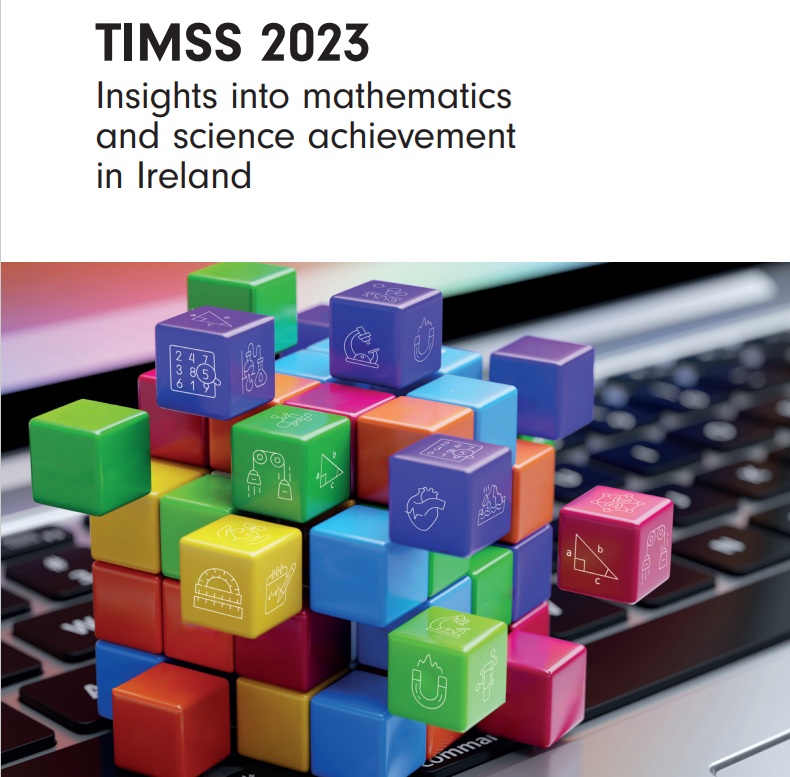
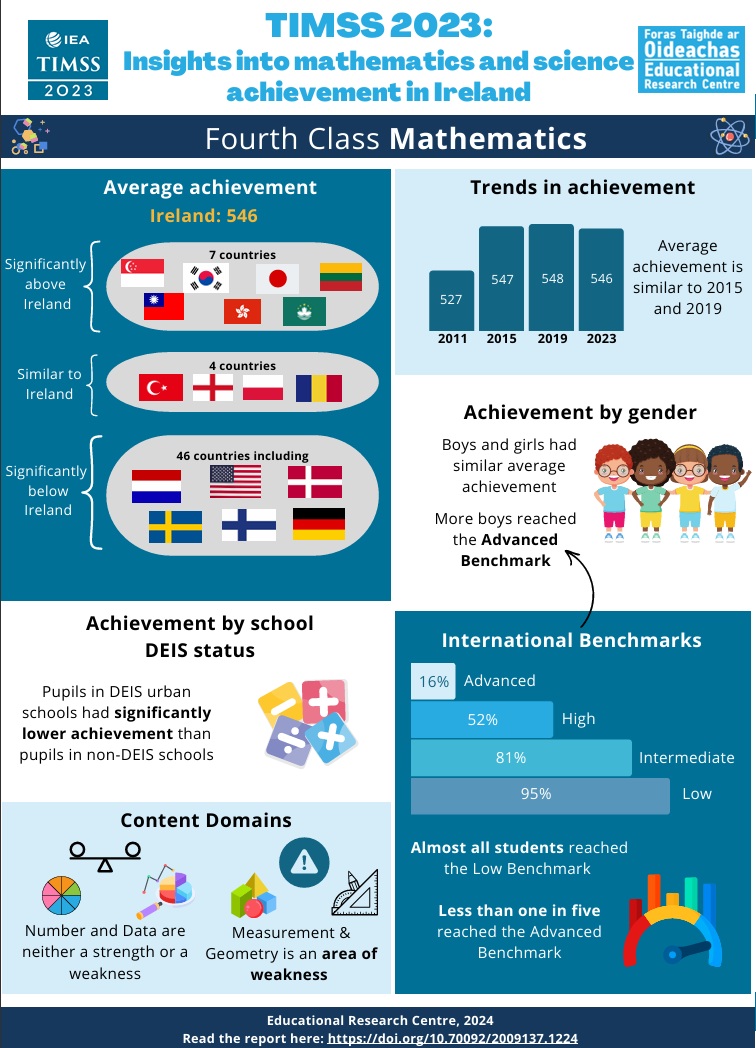
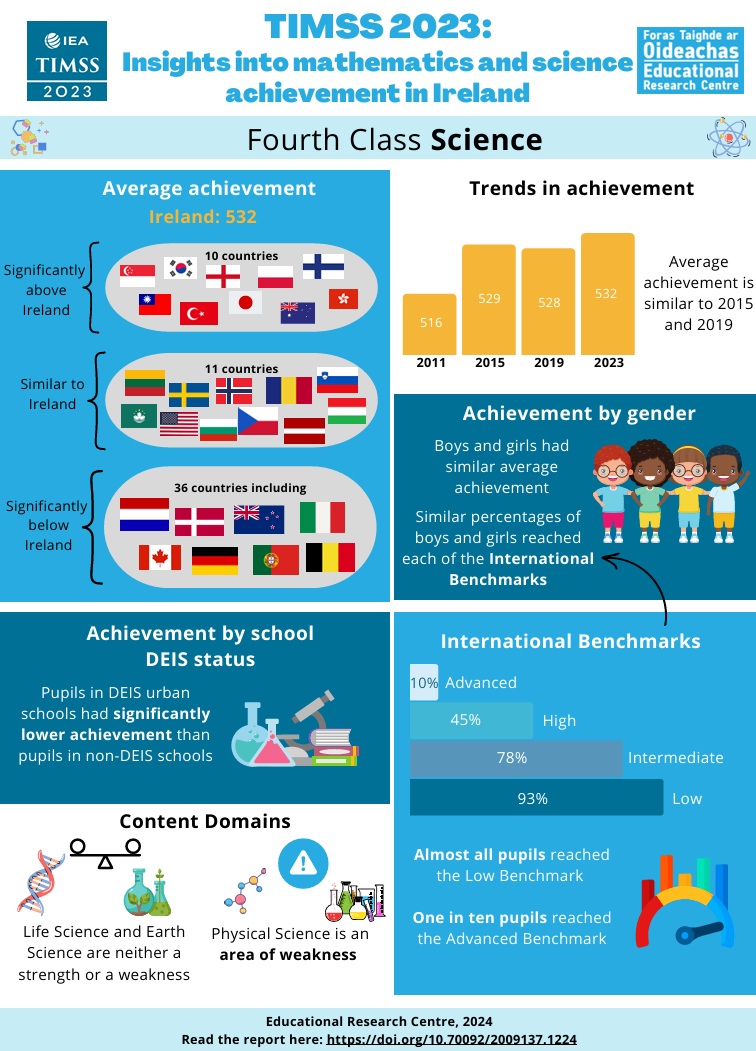
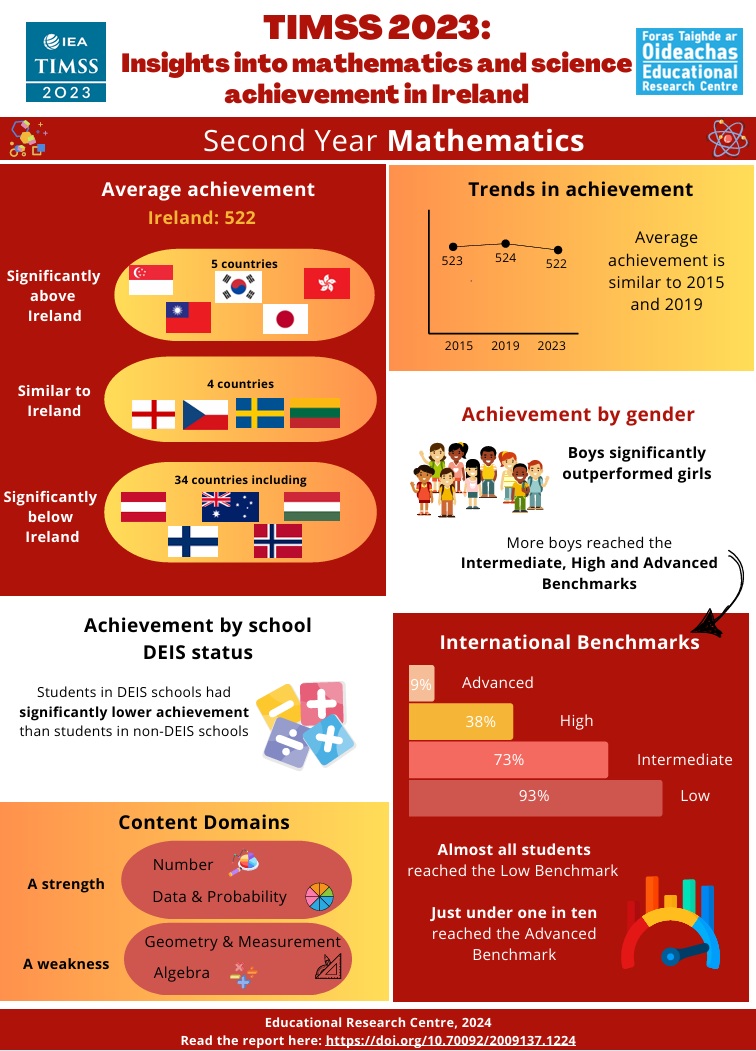
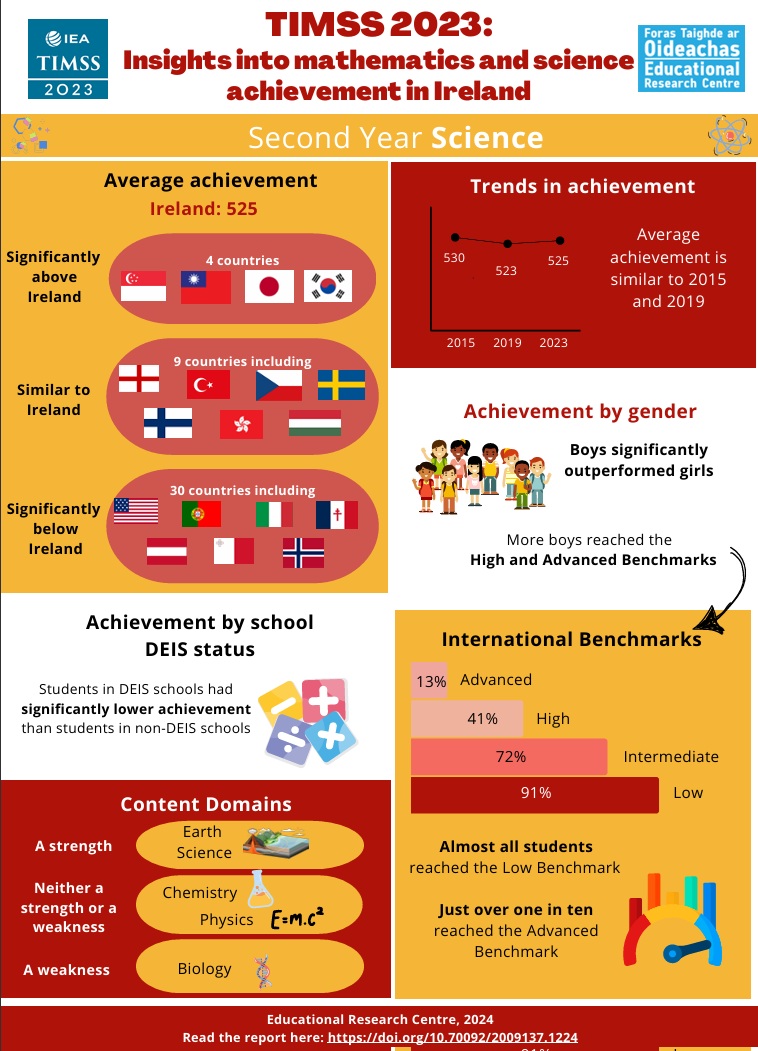
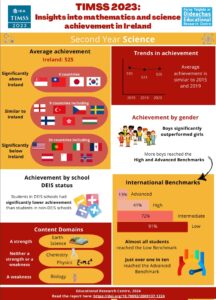
This report presents the achievement results for Ireland in the Trends in International Mathematics and Science Study (TIMSS) 2023. TIMSS assesses the mathematical and scientific knowledge and skills of students in Fourth Grade and Eighth Grade (Fourth Class and Second Year in Ireland). TIMSS is a study of the International Association for the Evaluation of Educational Achievement (IEA) and has been conducted every four years since 1995. TIMSS 2023 is the eighth cycle of the study and included 656,360 students from 65 countries.
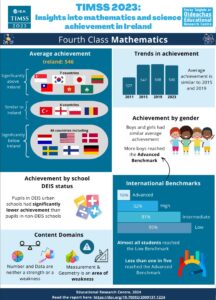
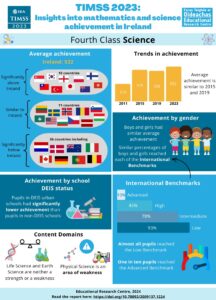
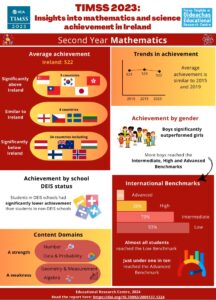
This national report focuses on trends in overall achievement in Ireland, as well as the distribution of achievement (performance at various percentiles), student performance at the TIMSS International Benchmarks, relative strengths and weaknesses on the TIMSS content and cognitive domains, and teachers’ reports of curriculum coverage. Performance in Ireland is explored in the context of selected countries; compared with previous cycles of TIMSS where data are available (since 2011 for Fourth Class and since 2015 for Second Year); and, where applicable, examined by gender and by socioeconomic status at both individual level and at school level (DEIS status).
TIMSS 2023 also marks Ireland’s transition from paper-based to digital testing, as part of which Ireland completed a national mode effect study to examine the extent to which any differences in student achievement exist between digital and paper testing. Initial findings from this mode effect study are also presented.
Finally, some conclusions and implications for policymakers in Ireland are outlined.
e-Appendix associated with this publication – download
Infographics
This is the final report on the Digital Learning Framework national longitudinal evaluation, following data collection for Wave 2 from Autumn 2021-May 2022. The data presented in this report provide an opportunity to consider how schools and students responded to the challenges of the COVID-19 pandemic with reference to the use of digital technologies for teaching, learning and assessment. The evaluation also considers the ways in which schools have had successes and met challenges in their embedding and implementation of the Department of Education’s Digital learning Framework. The report provides an overview of the current policy and research landscape with respect to the use of digital technologies in schools and over the course of the pandemic. It also presents new data at both primary and post-primary levels from schools (digital learning team leaders, school principals, and teachers), students, and professional development advisors specialising in the use of technology in education. The key findings from Wave 2 of the evaluation are highlighted, together with examination of changes from previous waves. Finally, the main successes and challenges encountered by schools in their implementation of the Digital Learning Framework over the period 2017-2022 are identified.
This report presents a detailed examination of reading literacy among primary school pupils in Ireland, focusing on the relationships of a wide range of contextual factors with pupils’ reading achievement. Drawing on data from the 2021 cycle of the Progress in International Reading Literacy Study (PIRLS), it delves into the demographic backgrounds and home environments of pupils, as well as their wellbeing, reading behaviours and attitudes, and digital attitudes. The report also explores the characteristics of teachers, their instructional approaches, the challenges they encounter in reading instruction, including challenges related to remote teaching and learning during the COVID-19 pandemic, and the composition, resources, and climate of schools. Key trends and international comparisons are presented, offering a global perspective on Ireland’s educational standing.
The findings are interpreted in light of national education policies and initiatives, particularly the National Strategy to Improve Literacy and Numeracy (2011-2020), and consider the profound impact of the COVID-19 pandemic on education. By identifying critical factors associated with reading achievement, the report provides essential insights into future policy directions and educational practices necessary to support and enhance literacy development in Ireland. It emphasises the importance of addressing inequalities in achievement, ensuring equitable access to educational resources, and adapting to the evolving needs of pupils in a post-pandemic educational environment.
Infographics
Attitudes to and Engagement in Reading
Educational Experiences During the COVID-19 Pandemic
Digital Reading
Low, Medium, and High Achievers in Reading
Reading Activities Inside and Outside of the Classroom
Pupil Wellbeing
Chapters: Executive Summary, Chapter 1, Chapter 2, Chapter 3, Chapter 4, Chapter 5, Chapter 6, Chapter 7, Chapter 8, Chapter 9
Appendices: Chapter 3, Chapter 4, Chapter 5, Chapter 6, Chapter 7, Chapter 8
This report provides a snapshot of the student experience of the first P-TECH student cohort in Ireland as they finish post-primary school. It looks at their views on school, their experiences in P-TECH and their plans for the future. A total of 49 students responded to the online survey, representing a response rate of nearly 64% of eligible students. Students’ views on school were somewhat divided with about one-third of students disagreeing or strongly disagreeing that they looked forward to school. Students’ reflections on their learning within P-TECH were largely positive. The majority of students (>80%) reported that P-TECH supported their development in various skill areas or abilities either to a small or large extent. One-third of students were happy with the availability of the P-TECH mentor for guidance and support when needed (33% satisfied/very satisfied). There was high uptake of the work experience placements in Transition Year. About two-thirds of students rated their interest, enjoyment or overall work placement experience as good. The majority of students intended to continue in formal education after school, intending to pursue either higher (59%) or further education (29%) courses. Over half of students (57%) reported that P-TECH was preparing them to some extent for their future career or further education . About half of students were satisfied or very satisfied with their overall experience of the programme. Students’ suggestions for improvement to the P-TECH programme included: clearer information on the programme’s content and goals; more information for students on P-TECH in general; clearer instructions for projects/tasks during work experience placements; and allowing students to provide ongoing feedback throughout the programme.
This report provides a snapshot of the student experience of the first P-TECH student cohort in Ireland as they finish post-primary school. It looks at their views on school, their experiences in P-TECH and their plans for the future. A total of 49 students responded to the online survey, representing a response rate of nearly 64% of eligible students. Students’ views on school were somewhat divided with about one-third of students disagreeing or strongly disagreeing that they looked forward to school. Students’ reflections on their learning within P-TECH were largely positive. The majority of students (>80%) reported that P-TECH supported their development in various skill areas or abilities either to a small or large extent. One-third of students were happy with the availability of the P-TECH mentor for guidance and support when needed (33% satisfied/very satisfied). There was high uptake of the work experience placements in Transition Year. About two-thirds of students rated their interest, enjoyment or overall work placement experience as good. The majority of students intended to continue in formal education after school, intending to pursue either higher (59%) or further education (29%) courses. Over half of students (57%) reported that P-TECH was preparing them to some extent for their future career or further education . About half of students were satisfied or very satisfied with their overall experience of the programme. Students’ suggestions for improvement to the P-TECH programme included: clearer information on the programme’s content and goals; more information for students on P-TECH in general; clearer instructions for projects/tasks during work experience placements; and allowing students to provide ongoing feedback throughout the programme.
This is the final report on the Digital Learning Framework national longitudinal evaluation, following data collection for Wave 2 from Autumn 2021-May 2022. The data presented in this report provide an opportunity to consider how schools and students responded to the challenges of the COVID-19 pandemic with reference to the use of digital technologies for teaching, learning and assessment. The evaluation also considers the ways in which schools have had successes and met challenges in their embedding and implementation of the Department of Education’s Digital learning Framework. The report provides an overview of the current policy and research landscape with respect to the use of digital technologies in schools and over the course of the pandemic. It also presents new data at both primary and post-primary levels from schools (digital learning team leaders, school principals, and teachers), students, and professional development advisors specialising in the use of technology in education. The key findings from Wave 2 of the evaluation are highlighted, together with examination of changes from previous waves. Finally, the main successes and challenges encountered by schools in their implementation of the Digital Learning Framework over the period 2017-2022 are identified
This report is aimed at informing the work of teachers, school leaders, teacher educators, and curriculum developers in Ireland. It describes in detail the performance of Fourth Class (primary) and Second Year (post-primary) students on a range of mathematics and science topics and test items. In interpreting the data presented here from the TIMSS 2019 study (the Trends in International Mathematics and Science Study), students’ performance is discussed with reference to relevant aspects of the Irish curricula for mathematics and science, and to international comparisons of student performance.
The findings presented here build on the initial national report on TIMSS 2019 (Perkins & Clerkin, 2020), which described student performance in mathematics and science in terms of average achievement, distributions of achievement among higher- and lower-achieving students, gender differences, benchmarks of performance (Low, Intermediate, High, or Advanced), and high-level
descriptions of performance on the TIMSS cognitive and content domains. This report expands on the latter aspect by providing a detailed examination of Fourth Class and Second Year students’ performance on the TIMSS content domains and, in particular, on their constituent subdomains and topic areas.
Associated e-appendices
Flyers
Strengths and Weaknesses in Maths and Science at Fourth Class
Strengths and Weaknesses in Maths and Science at Second Year
Published in: Irish Educational Studies
Abstract:
In recent years, countries including the UK and USA have seen advancements in the use of Randomised Controlled Trials in education, progress that has not been mirrored in Ireland. Ireland does not have a strong tradition of using experimental or quasi-experimental evaluation designs for monitoring and evaluation of education policy despite well-articulated commitments to the latter activities. An example is the evaluation of the Delivering Equality of Opportunity in Schools (DEIS) programme where little is known about the causal impact of DEIS on student outcomes, despite considerable State investment over almost 20 years. There appears to have been comparatively little critical review of the literacy and numeracy programmes offered to DEIS schools, with those included at the outset largely still on offer. Here, we draw on the wider literature on the evaluation of complex interventions and consider what lessons may be learned for Ireland, illustrating challenges and opportunities by focusing on DEIS and Reading Recovery (a literacy support programme widely used in DEIS schools). We advocate for greater use of experimental designs where feasible and appropriate; further gathering of comparable measures of achievement at pupil level to facilitate monitoring; and detailed consideration of quasi-experimental methods that can support causal conclusions.
Gilleece, L. & Clerkin, A. (2024). Towards more robust evaluation of policies and programmes in education: Identifying challenges in evaluating DEIS and Reading Recovery. Irish Educational Studies, 1-29. https://doi.org/10.1080/03323315.2024.2334704
The Progress in International Reading Literacy Study (PIRLS) assesses the reading literacy of primary school pupils in participating countries worldwide. Ireland has participated in three cycles of PIRLS to date—in 2011, 2016, and 2021—with the Educational Research Centre (ERC) administering the study on behalf of the Department of Education.
This report draws on data from PIRLS 2021. PIRLS was one of two large-scale assessments conducted in primary schools in Ireland in 2021, the other being the National Assessments of
Mathematics and English Reading (NAMER). Together, PIRLS and NAMER data provide valuable insights about primary school pupils’ achievement and experiences following the disruptions
to education caused by COVID-19 within the Irish context, while findings across PIRLS countries further contextualise these outcomes on a global scale.
Findings in this report build on those reported in the PIRLS 2021 national report by Delaney et al. (2023). Readers may find it useful to also consult the international PIRLS 2021 report (Mullis
et al., 2023), the PIRLS 2021 Encyclopedia (Reynolds et al., 2022), as well as the NAMER 2021 performance report (Kiniry et al., 2023) and the NAMER 2021 report on DEIS schools (Nelis &
Gilleece, 2023).