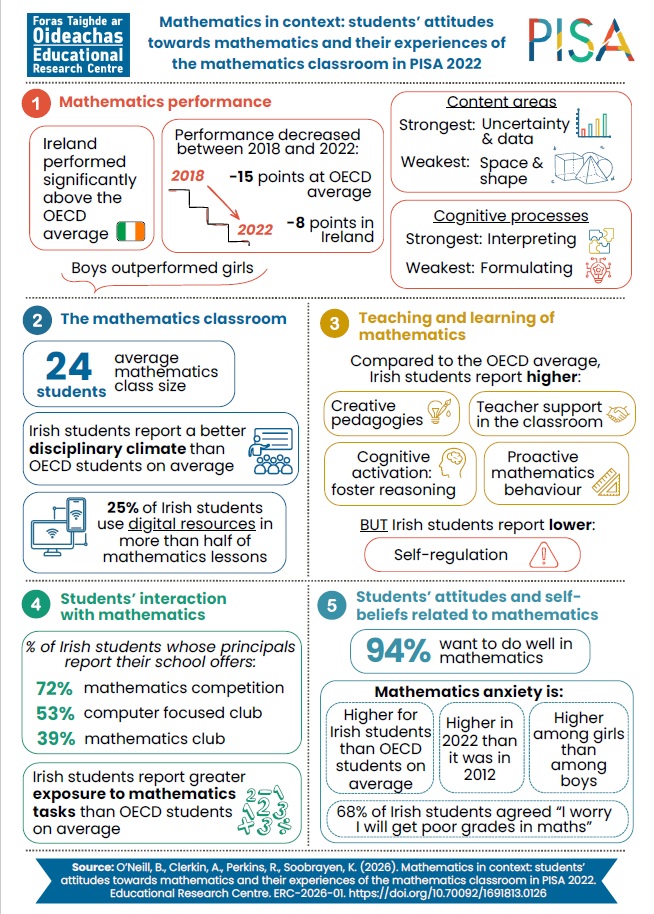
Mathematics in context: students’ attitudes towards mathematics and their experiences of the mathematics classroom in PISA 2022

This report describes students’ experiences of mathematics in Ireland, their feelings towards the subject, and also trends in mathematics performance, both overall and across different content areas and cognitive processes. Drawing on data from the 2022 cycle of Programme for International Student Assessment (PISA), collected from 15-year-old students and their school principals, various aspects related to the teaching and learning of mathematics are examined and compared with international averages for the OECD and the EU. The composition of the mathematics classroom, and the role of digital technologies, are examined along with the disciplinary climate in the mathematics classroom. Student perceptions of various teaching behaviours and their own learning strategies are explored. The report goes on to look at students’ familiarity with and exposure to various aspects of mathematics, their attitudes towards mathematics and the extent of confidence and anxiety associated with mathematics, concluding with a discussion of the key themes that emerge from the data.

The e-Appendix to this report is available: PISA 2022 Mathematics in context E-appendix.

Infographic

Computer-based testing in Ireland, 2005-2024: Challenges, lessons learned, and future possibilities.

Published in: E-testing and computer-based assessment: CIDREE Yearbook 2024

Abstract:

This chapter traces the use of computer-based testing in schools in Ireland in two contexts: international large-scale assessments (ILSAs) (since 2005) and national standardised testing (since 2016). Learning gleaned from Ireland’s participation in computer-based ILSAs informed the development of a bespoke online platform for administering and scoring standardised tests (the ERC Drumcondra Online Testing System [ERC DOTS]). Conversely, knowledge about schools’ use of ERC DOTS has informed Irish approaches in subsequent ILSA cycles. Across ILSAs and standardised testing, recurrent challenges of computer-based testing are identified, including wide variation in: (i) education technology infrastructure in schools, and (ii) students’ prior experiences using this for schoolwork. Although common to primary and post-primary settings, infrastructural challenges were most apparent at primary level while differences in students’ experience were most pronounced below Grade 3. Adaptations and solutions trialled are discussed. Looking ahead, further possibilities of computer-based testing, including enhanced accessibility, additional item types, and adaptive testing, are considered.

Delaney, E., O’Flaherty, A., Perkins, R., Clerkin, A., & Cunningham, R. (2024). Computer-based testing in Ireland, 2005-2024: Challenges, lessons learned, and future possibilities. In B. Ranđelović et al. (eds), E-testing and computer-based assessment: CIDREE Yearbook 2024. CIDREE. https://www.cidree.org/wp-content/uploads/2024/11/cidree_yearbook-2024.pdf

An in-depth analysis of the relative strengths and weaknesses of students in Ireland in mathematics and science in TIMSS 2019

This report is aimed at informing the work of teachers, school leaders, teacher educators, and curriculum developers in Ireland. It describes in detail the performance of Fourth Class (primary) and Second Year (post-primary) students on a range of mathematics and science topics and test items. In interpreting the data presented here from the TIMSS 2019 study (the Trends in International Mathematics and Science Study), students’ performance is discussed with reference to relevant aspects of the Irish curricula for mathematics and science, and to international comparisons of student performance.

The findings presented here build on the initial national report on TIMSS 2019 (Perkins & Clerkin, 2020), which described student performance in mathematics and science in terms of average achievement, distributions of achievement among higher- and lower-achieving students, gender differences, benchmarks of performance (Low, Intermediate, High, or Advanced), and high-level
descriptions of performance on the TIMSS cognitive and content domains. This report expands on the latter aspect by providing a detailed examination of Fourth Class and Second Year students’ performance on the TIMSS content domains and, in particular, on their constituent subdomains and topic areas.

Associated e-appendices


Flyers

Strengths and Weaknesses in Maths and Science at Fourth Class

Strengths and Weaknesses in Maths and Science at Second Year

Cultivating Creativity: What the PISA 2022 results say about creative thinking in Ireland.

Appendix

Trends in educational inequalities in Ireland’s primary schools: an analysis based on TIMSS data (2011-2019).

Published in:  Large Scale Assessments in Education


Abstract:

Background

Socioeconomic characteristics are persistently and systematically related to academic outcomes, despite long-standing efforts to reduce educational inequality. Ireland has a strong policy focus on alleviating educational disadvantage and has seen significant improvements in mathematics and science performance in recent years. This study investigates patterns of socioeconomic inequalities in 4th grade students’ performance in mathematics and science between 2011 and 2019. Two measures of inequality are examined: (i) inequality of achievement, i.e., the degree of variability in student performance and (ii) inequality of opportunity, i.e., the extent to which student performance is related to background characteristics.

Methods

Data for 4th-grade students in Ireland from TIMSS 2011, TIMSS 2015 and TIMSS 2019 were used. Mathematics and science achievement were the main outcome measures. The home resources for learning index was used as a proxy for student-level socioeconomic status. School-level socioeconomic status was examined according to schools’ participation in the Delivering Equality of Opportunity in Schools (DEIS) programme, which is the Department of Education’s main policy initiative addressing educational disadvantage. Descriptive and multilevel regression analyses were conducted to explore variability in student performance and to investigate the variance in achievement explained by socioeconomic factors, across cycles and subjects.

Results

Between 2011 and 2015, between-student and between-school differences in mathematics and science performance became smaller, as shown by the decrease in standard deviations and the intraclass correlation coefficients (ICCs). This points to reduced inequality of achievement. Between 2015 and 2019, a small increase in inequality of achievement was observed.

Regarding inequality of opportunity, students’ home resources for learning and school disadvantaged status were statistically significantly related to mathematics and science achievement across all three cycles. Overall variance explained by these two variables increased from 2011 to 2019. This points towards increasing inequality of opportunity over the period examined.

Performance gaps between disadvantaged and non-disadvantaged schools have been reduced over time; however, the relationship between home resources for learning and achievement appears to have strengthened. Findings were consistent for both subjects.

Conclusions

The findings indicate that improvements in overall performance do not necessarily reflect improved equality. Ireland’s improvements in average mathematics and science performance between 2011 and 2015 were accompanied by reduced inequality of achievement. Performance differences between disadvantaged and non-disadvantaged schools have been reduced over time, suggesting that the DEIS policy is meeting its goal of narrowing achievement gaps based on concentrations of educational disadvantage. However, inequality of opportunity linked to student-level socioeconomic factors (i.e., home resources for learning) appears to have increased over time. These findings are valuable in the context of measuring and tracking educational inequalities.

Duggan, A., Karakolidis, A., Clerkin, A., Gilleece, L., & Perkins, R. (2023). Trends in educational inequalities in Ireland’s primary schools: an analysis based on TIMSS data (2011-2019). Large Scale Assessments in Education, 11(39). https://doi.org/10.1186/s40536-023-00188-2

Education in a Dynamic World: the performance of students in Ireland in PISA 2022

The Programme for International Student Assessment (PISA) is an assessment of the skills and knowledge of 15-year-olds in science, reading literacy and mathematics. It is an initiative of the
Paris-based Organisation for Economic Cooperation and Development (OECD). PISA takes place every three years. The first PISA cycle was implemented in 2000 and PISA 2022 is the eighth iteration of the study. In each cycle, one domain is designated a major domain, and the remaining domains function as minor domains. In PISA 2022, mathematics was the major assessment domain, while science and reading literacy were minor domains. An international consortium, led by Educational Testing Service (ETS) in United States, was responsible for the implementation of PISA.

The usual pattern of the PISA cycle was interrupted in this iteration, as the planned implementation of the Main Study in 2021 was delayed by one year to 2022 due to disruptions associated with the COVID-19 pandemic.

A further change in administration took place in Ireland, with Main Study data collection taking place in autumn instead of springtime. In response to reports of a crowded school calendar in springtime, and in an attempt to reduce the burden on schools, the decision was made to move main study testing to the autumn time. This means that data were collected a year and a half later than originally planned, and four and a half years since data were collected in the 2018 cycle of PISA.

This was the third cycle in which testing was administered principally on computer. Following the 2018 cycle, in which adaptive testing was introduced for the first time, in 2022 two domains (reading and mathematics) incorporated a multi-stage adaptive testing design (MSAT). PISA 2022 was administered in 81 participating countries/economies, including 37 OECD countries,
with tests and questionnaires completed by 690,000 students internationally. In Ireland, 5569 students in 170 schools took part, with the majority of participants in Transition Year and Third Year, with smaller proportions in the remaining years.

The OECD has published an assessment framework (2023a), and a technical report is also expected to be released in early 2024 (OECD, in press). Two volumes on the main outcomes of PISA 2022 will be published simultaneously with the launch of the results: PISA 2022 Results (Volume 1): The State of Learning and Equity in Education (OECD, 2023c), PISA 2022 Results (Volume 2): Resilient Systems, Schools and Students (OECD, 2023d).

This report, which provides an overview of the main outcomes of PISA 2022 in Ireland, is the first in a series of national reports based on the 2022 data, and will be followed by short, thematic reports on the themes of mathematics, learning in the pandemic, well-being and home environment, and creative thinking.
This report is divided into seven chapters. Chapter 1 provides an overview of the PISA 2022 cycle, and describes its implementation in Ireland. Chapter 2 summarises previous PISA performance in Ireland, and looks at the broader research and policy context. Chapters 3, 4, and 5 describes Ireland’s achievement in PISA 2022 in the domains of mathematics, reading and science respectively, and link performance to background characteristics such as ESCS, gender and immigrant status. Chapter 6 reports on students’ experiences of learning during the school closures associated with the COVID-19 pandemic. A summary and conclusions are presented in Chapter 7

PISA 2022 Non-response bias analysis for Ireland

An examination of science achievement and school compositional effects in Ireland using TIMSS data.

Published in: European Journal of Educational Research

Abstract:

Recent educational policy initiatives in Ireland have focused on improving outcomes in reading and mathematics among students, particularly those experiencing educational disadvantage. However, science achievement in Irish primary schools has received much less research attention, especially in the context of educational disadvantage. This article examines science achievement and its relationship to school compositional effects in primary schools at the national level, including school-average indicators of the school context, as well as examining factors associated with science achievement in three distinct categories of schools (those with high, moderate, or minor levels of educational disadvantage). The data are drawn from the Fourth grade Trends in International Mathematics and Science Study (TIMSS) 2015 database for Ireland. Multilevel analyses were implemented in a stepwise manner. Findings suggest the relevance of school contexts with regard to science achievement. Before including school-level contextual variables, students from ‘minor disadvantaged’ schools achieved significantly higher science scores than students from schools with ‘moderate’ or ‘high’ levels of disadvantaged. However, this difference disappears after controlling for predictors at the school level. The findings highlight the importance of the home environment, including early numeracy activities and skills before children start school. Results are discussed with regard to educational policy and educational practice in Ireland.

Nonte, S., Clerkin, A., & Perkins, R. (2022). An examination of science achievement and school compositional effects in Ireland using TIMSS data. European Journal of Educational Research, 11(4), 2523-2536. https://doi.org/10.12973/eu-jer.11.4.2523

Digital Technologies in Education – Ireland in the International Context: Trends and Implications from PISA 2012-2018

TIMSS 2019: Ireland’s results in mathematics and science

Students’ perspectives on learning mathematics and science: Results from TIMSS 2015 in Ireland

The home learning environment in Ireland: Insights from TIMSS 2015