

The Programme for International Student Assessment (PISA) is a global study conducted by the Organisation for Economic Co-operation and Development (OECD) that assesses the knowledge and skills of 15-year-olds in science, reading, mathematics, and an innovative domain that changes each cycle. PISA 2025 is the ninth cycle of the study, in which students from Ireland and 90 more countries and economies took part. This national report focuses on student performance in PISA 2025. It examines how students in Ireland and in other participating countries/economies performed in PISA 2025, draws comparisons with previous cycles, and provides reference estimates for comparison countries, as well as for the average across OECD and European Union (EU) countries. Student performance is also described in terms of proficiency levels. Finally, the report examines the relationship between performance and key student- and school-level factors.
Year: 2026
Mode effects in the transition to digital testing: Evidence from TIMSS in Ireland, Azerbaijan, Bahrain, and Flanders
Published in: Large-scale Assessments in Education
Abstract:
Background
About half of the countries participating in TIMSS 2019 transitioned from paper-based to digital assessment in that cycle, with most remaining countries completing the transition in TIMSS 2023. All countries transitioning in 2019 completed a paper-based ‘bridge’ study to examine mode effects (differences in achievement related to the mode of administration) and ensure the comparability of scores from previous cycles. However, only four countries opted to administer a national comparison (bridge) study in 2023: Ireland, Azerbaijan, Bahrain, and Flanders (Belgium). This Brief Report documents findings from these four national comparison studies. The aim is to verify the extent to which the transition to digital testing may have affected student performance in these countries, noting that ten countries in TIMSS 2019 were previously found to have displayed country-level mode effects in at least one subject or grade.
Findings
We find no evidence of significant differences in overall performance by mode of administration, in either mathematics or science, in any of the four included countries. We also find no evidence of significant mode effects among boys or girls in Ireland, Flanders, or Bahrain. In Azerbaijan, boys achieved a significantly higher science score on the digital version of TIMSS compared to the paper version. Some differences in achievement by mode are observed at the level of the mathematics and science content and cognitive domains. These are limited and present no distinctive pattern in three of the countries studied although, again, more consistent differences are noted in Azerbaijan. Finally, some preliminary evidence is presented of differences in student performance on the digital assessment related to students’ access to a computer at home in Flanders, Bahrain, and Azerbaijan.
Conclusions
The findings provided here confirm that achievement estimates in TIMSS 2023 in these four countries were substantively unaffected at a high level by the change in the mode of administration. This should strengthen confidence in the use of these data for policymaking, educational practice, and further research. In particular, trend data from 2019 to 2023 in these countries can be more confidently interpreted as reflecting substantive trends or changes in achievement, giving researchers greater confidence that trends have not been significantly confounded by the procedural change of assessment mode. Evidence of some specific differences in each country could be considered further by national experts in curriculum and assessment. In particular, several differences have been observed that merit further consideration by researchers and policymakers in Azerbaijan.
Citation: Clerkin, A., Verhelst, D., Mahdi, A., Mammadov, S & McHugh, G. (2026). Mode effects in the transition to digital testing: Evidence from TIMSS in Ireland, Azerbaijan, Bahrain, and Flanders. Large-scale Assessments in Education, 14, 4. https://doi.org/10.1186/s40536-026-00313-x
Reflections on the National Literacy and Numeracy Strategy 2011-2020: Evidence from TIMSS and PIRLS (2011-2023)
Published in: Irish Journal of Education
Abstract:
The National Strategy to Improve Literacy and Numeracy Among Children and Young People 2011-2020 (hereinafter referred to as the 2011 Strategy) was one of the flagship policy initiatives of the Department of Education and Youth for much of the last 15 years. Amongst other aspects, it set out significant goals relating to initial teacher education, instructional time, parental involvement, assessment practices and use of standardised tests, use of large-scale assessment data for system-level monitoring, and major curriculum reform. The publication of a successor Literacy, Numeracy and Digital Literacy Strategy in 2024 – covering the next decade up to 2033 – creates a follow on from the 2011 Strategy. It therefore seems timely now to look back over the 2011-2023 period to examine the extent to which progress towards a set of aims specified in the 2011 Strategy had been accomplished by its endpoint.
For this analysis, we draw on data from multiple cycles of two large-scale assessments: PIRLS 2011, TIMSS 2011, PIRLS 2021, and TIMSS 2023. These studies, which are conducted at Fourth Class in primary school, fulfil three key criteria for the current purpose: (i) they provide population-level data that allow generalisations to be made to the relevant population of pupils across the country as a whole, rather than just a sample; (ii) they provide comparable datapoints on key topics at either side of the lifetime of the 2011 Strategy; and (iii) they provide data relevant to the teaching and learning of both literacy and numeracy. Findings are presented under the six “pillars” alluded to in the 2011 Strategy and a subsequent 2017 Interim Review. Next, the findings are contextualised from an international perspective, highlighting common drivers for policy creation, approaches used when policymaking, and challenges that arise when trying to evaluate the effectiveness of policy. The findings and contextualisation inform a discussion on the changes and progress in the lifetime of the 2011 Strategy while considering the updated goals and objectives set out in the current Literacy, Numeracy and Digital Literacy Strategy 2024-2033.
McHugh, G., Clerkin, A., & Hastedt, D. (2026). Reflections on the National Literacy and Numeracy Strategy 2011-2020: Evidence from TIMSS and PIRLS (2011-2023). Irish Journal of Education, 50(4), 1-49. https://doi.org/10.70092/IJE.50.04
Six strategies for bridging the transition to post-16 chemistry: Ireland’s Transition Year model.
Published in: Education in Chemistry
Abstract:
Article on science education in Ireland’s Transition Year alongside contributions from science teachers in Northern Ireland, England, Scotland and Wales.
Clerkin, A. (2026). Six strategies for bridging the transition to post-16 chemistry: Ireland’s Transition Year model. Education in Chemistry. https://edu.rsc.org/ideas/how-to-manage-the-transition-from-pre-to-post-16-chemistry/4022624.article
Learning from employers’ perspectives on Transition Year work experience
Published in: Irish Educational Studies
Abstract:
Work experience is regarded as a vital component of Transition Year (TY) by students, parents, and teachers. Despite this centrality, the manner in which placements are organised has evolved in an ad hoc manner, and limited attention has been paid to the perspectives of hosting organisations. This study explores the experiences and views of 11 providers of TY placements. Situating TY work experience within its historical and policy context and drawing on research on work-based learning and career development, the paper examines providers’ motivations, expectations, and challenges. While organisations expressed strong commitment to supporting young people’s early engagement with the world of work, the findings reveal significant ambiguities concerning the educational purpose of placements and the nature of school-employer relationships. The study argues that stronger structures, clearer shared understandings, and more systematic engagement between schools and providers are needed for the full potential of TY work experience to be realised.
Clerkin, A., & Jeffers, G. (2026). Learning from employers’ perspectives on transition year work experience. Irish Educational Studies, 1–31.
Assessing inconsistent responding in digital and paper formats: A replication study using the TIMSS 2023 Confidence in Mathematics scale in Ireland
Published in: Frontiers in Psychology
Abstract:
This study replicates and extends previous research on inconsistent responding in mixed-worded scales. Using a posttest-only experimental design, we examine the prevalence of inconsistent responding on the TIMSS 2023 Confidence in Mathematics Scale by comparing randomly equivalent digital and paper questionnaire administrations in Ireland. Two detection methods are employed: Mean Absolute Difference and Factor Mixture Analysis. Results indicate slightly higher rates of inconsistent responding in digital than in paper administration formats across most comparisons. Also, fourth-grade students exhibited higher rates of inconsistent responding compared to eighth-grade students. The study further investigates the role of student characteristics in predicting inconsistent responding. Among student background and digital-specific variables considered in binary logistic regression models, mathematics achievement was the only systematic negative predictor of inconsistent responding, explaining most of the variance, especially in younger students. This study highlights the importance of considering administration mode in large-scale assessments and provides implications for survey methodology, especially as digital testing becomes more widespread.
Konstantinidou, E., Pitsia, V., Clerkin, A., & Michaelides, M. P. (2026). Assessing inconsistent responding in digital and paper formats: a replication study using the TIMSS 2023 Confidence in Mathematics scale in Ireland. Frontiers in Psychology, 17, 1817706. https://doi.org/10.3389/fpsyg.2026.1817706
Mathematics in context: students’ attitudes towards mathematics and their experiences of the mathematics classroom in PISA 2022
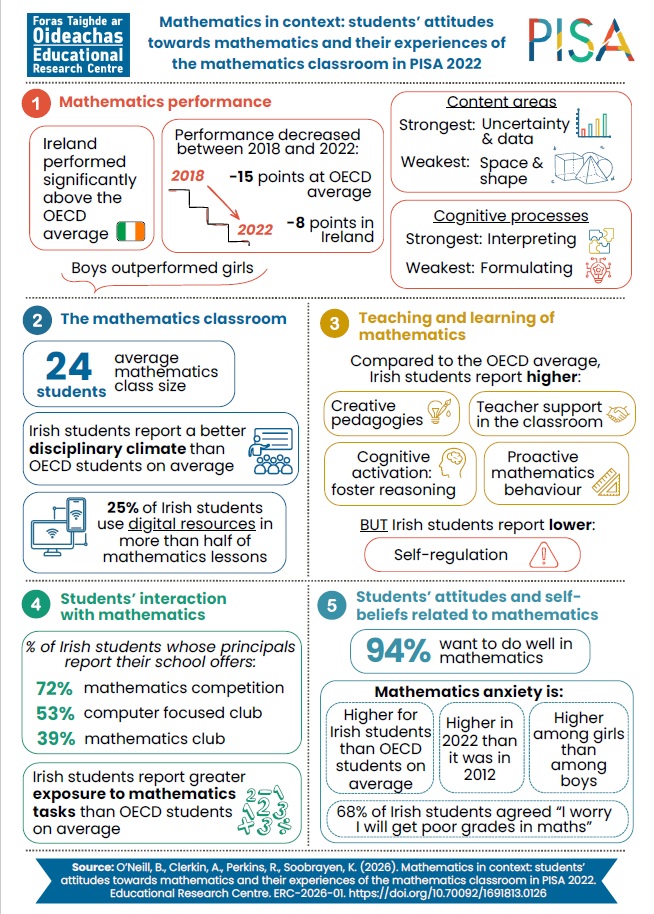
This report describes students’ experiences of mathematics in Ireland, their feelings towards the subject, and also trends in mathematics performance, both overall and across different content areas and cognitive processes. Drawing on data from the 2022 cycle of Programme for International Student Assessment (PISA), collected from 15-year-old students and their school principals, various aspects related to the teaching and learning of mathematics are examined and compared with international averages for the OECD and the EU. The composition of the mathematics classroom, and the role of digital technologies, are examined along with the disciplinary climate in the mathematics classroom. Student perceptions of various teaching behaviours and their own learning strategies are explored. The report goes on to look at students’ familiarity with and exposure to various aspects of mathematics, their attitudes towards mathematics and the extent of confidence and anxiety associated with mathematics, concluding with a discussion of the key themes that emerge from the data.
The e-Appendix to this report is available: PISA 2022 Mathematics in context E-appendix.