


The Programme for International Student Assessment (PISA) is a global study conducted by the Organisation for Economic Co-operation and Development (OECD) that assesses the knowledge and skills of 15-year-olds in science, reading, mathematics, and an innovative domain that changes each cycle. PISA 2025 is the ninth cycle of the study, in which students from Ireland and 90 more countries and economies took part. This national report focuses on student performance in PISA 2025. It examines how students in Ireland and in other participating countries/economies performed in PISA 2025, draws comparisons with previous cycles, and provides reference estimates for comparison countries, as well as for the average across OECD and European Union (EU) countries. Student performance is also described in terms of proficiency levels. Finally, the report examines the relationship between performance and key student- and school-level factors.
Area: PISA
Mathematics in context: students’ attitudes towards mathematics and their experiences of the mathematics classroom in PISA 2022
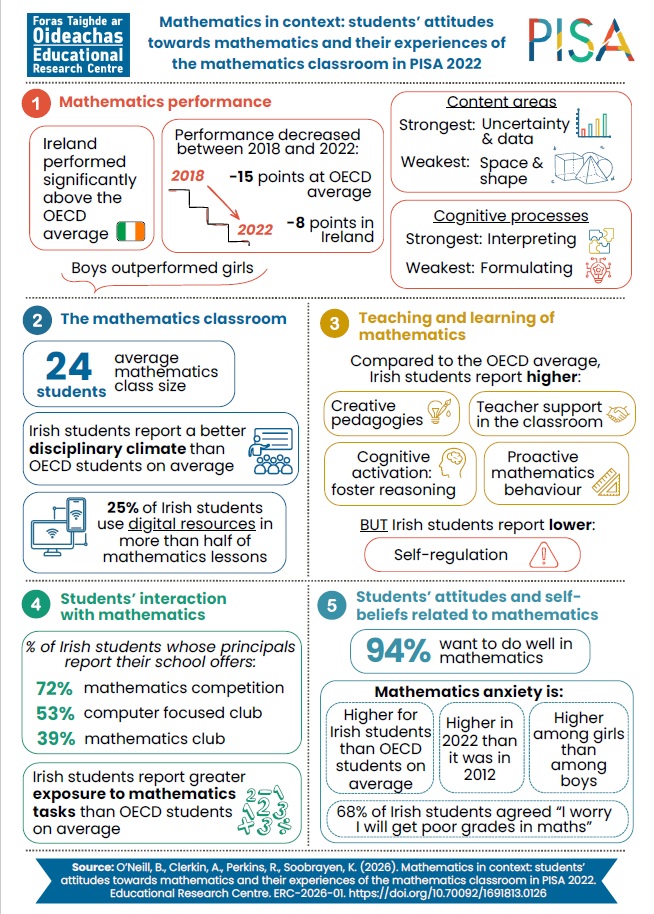
This report describes students’ experiences of mathematics in Ireland, their feelings towards the subject, and also trends in mathematics performance, both overall and across different content areas and cognitive processes. Drawing on data from the 2022 cycle of Programme for International Student Assessment (PISA), collected from 15-year-old students and their school principals, various aspects related to the teaching and learning of mathematics are examined and compared with international averages for the OECD and the EU. The composition of the mathematics classroom, and the role of digital technologies, are examined along with the disciplinary climate in the mathematics classroom. Student perceptions of various teaching behaviours and their own learning strategies are explored. The report goes on to look at students’ familiarity with and exposure to various aspects of mathematics, their attitudes towards mathematics and the extent of confidence and anxiety associated with mathematics, concluding with a discussion of the key themes that emerge from the data.
The e-Appendix to this report is available: PISA 2022 Mathematics in context E-appendix.
The well-being of Irish adolescents: Evidence from PISA 2022
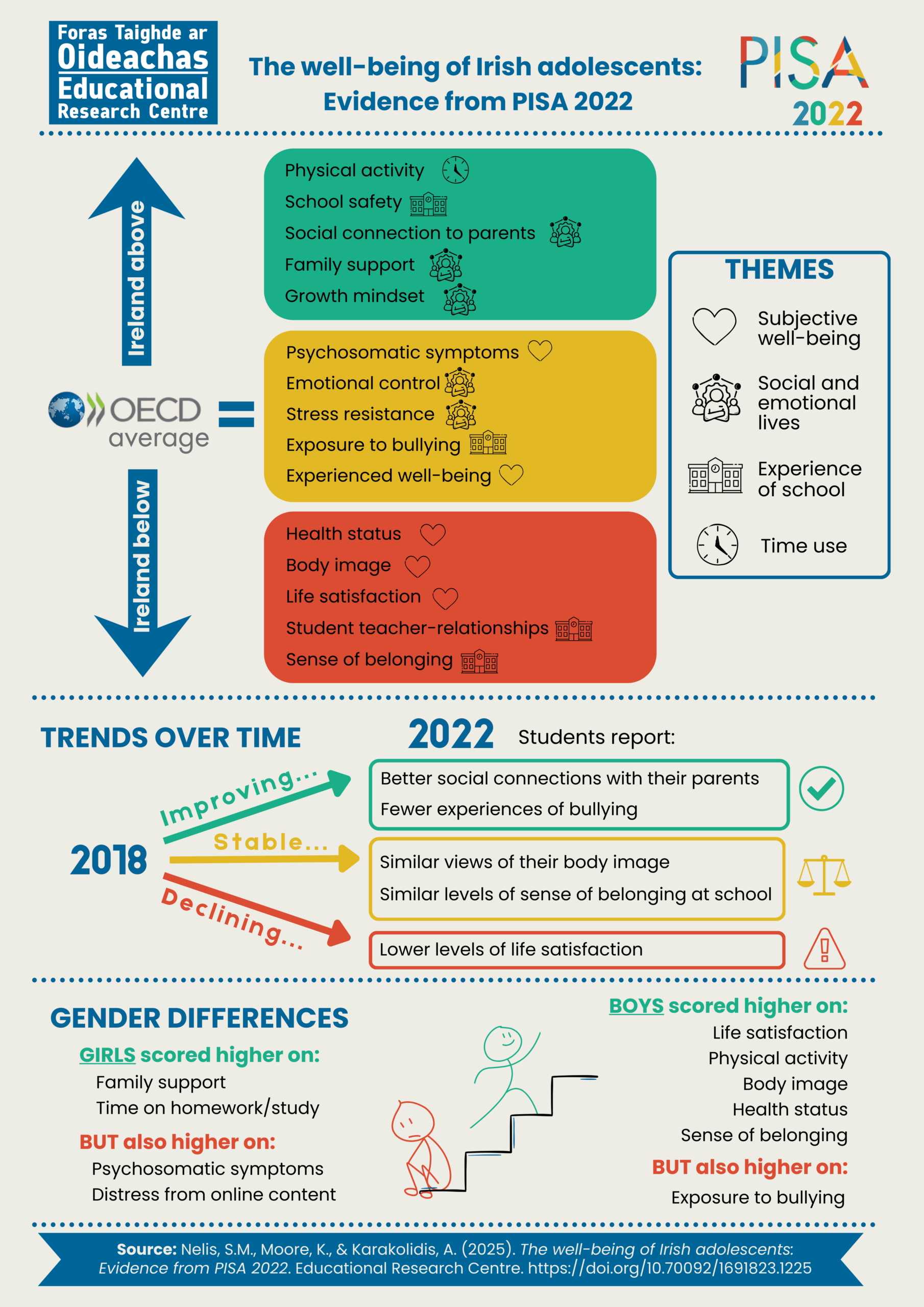
This report provides a wide–ranging set of findings from PISA 2022 on 15–year–old students’ well–being in Ireland. Compared to OECD peers, it highlights areas of strength for Irish students, such as social connection to family and friends, growth mindset, physical activity, sense of school safety, distress from online content and cyberbullying; comparable results in areas such as psychosomatic symptoms, experienced well–being and bullying; and also highlights the need for improvement in students’ views on their health, body image, life satisfaction, relationships with their teachers and sense of belonging at school. Gender gaps were evident as female students experience poorer well–being across a large range of indicators compared to their male peers. Ensuring that appropriate systems, services, and supports are in place for adolescent well–being should remain a key policy priority.
Publication date: December 15 2025
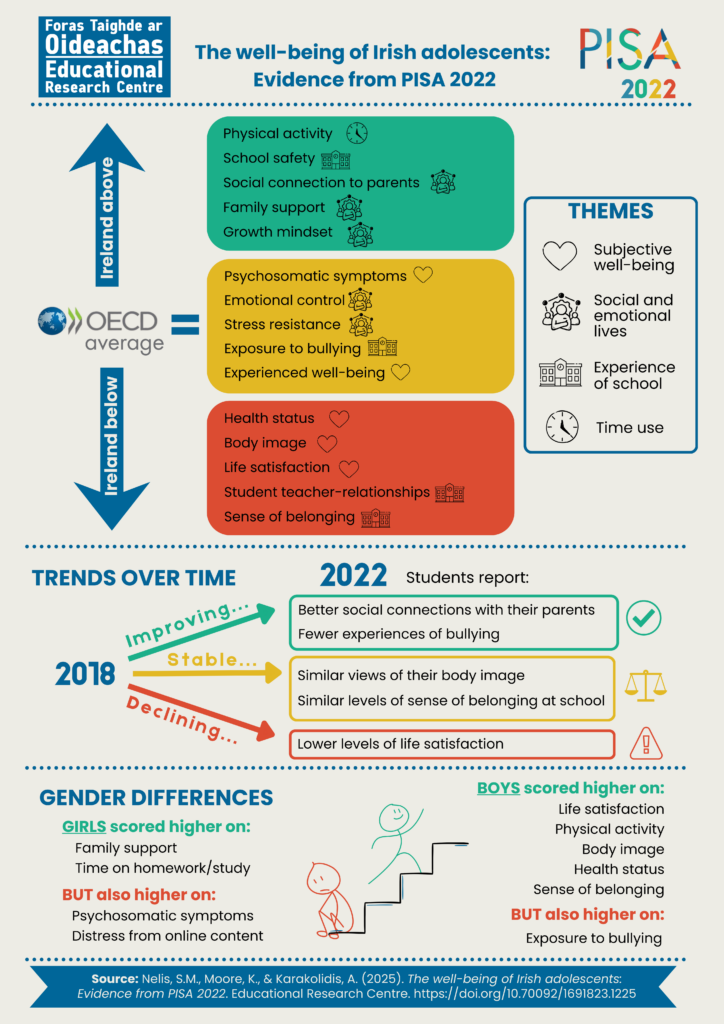
Click to enlarge
The profile of post-primary mathematics teachers in Ireland: Evidence from PISA 2022
Drawing on data from the PISA 2022 national teacher questionnaire, the present report provides an overview of post–primary mathematics teachers in Ireland, their backgrounds and professional profiles, their working life, their views on teaching mathematics, as well as their teaching practices and use of digital resources in Ireland.
How Large-Scale Assessments Have Informed Education Policy in Ireland
Published in: IEA Compass: Briefs in Education
Abstract:
In recent decades, large-scale assessments in Ireland have revealed consistent trends, phases of change, and some surprises. This Compass Brief explores how data from large-scale assessments informed Ireland’s National Literacy and Numeracy Strategy 2011–2020, particularly regarding priorities, target-setting, and monitoring. It also examines how related initiatives including curriculum redevelopment and standardized testing reform have reflected large-scale assessment findings. Looking ahead, we outline how large-scale assessments can inform Ireland’s next National Strategy to 2033, which encompasses digital literacy along with literacy and numeracy. More broadly, using Ireland as an example, we identify important issues for policymakers in other countries to consider when using ILSA (international large-scale assessment) data within their own national contexts.
Clerkin, A., & Delaney, E. (2025). How Large-scale Assessments Have Informed Education Policy in Ireland. IEA Compass: Briefs in Education #26. IEA. https://www.iea.nl/sites/default/files/2025-01/CB26-LSA-Data-Informing-Policy-Ireland.pdf
Computer-based testing in Ireland, 2005-2024: Challenges, lessons learned, and future possibilities.
Published in: E-testing and computer-based assessment: CIDREE Yearbook 2024
Abstract:
This chapter traces the use of computer-based testing in schools in Ireland in two contexts: international large-scale assessments (ILSAs) (since 2005) and national standardised testing (since 2016). Learning gleaned from Ireland’s participation in computer-based ILSAs informed the development of a bespoke online platform for administering and scoring standardised tests (the ERC Drumcondra Online Testing System [ERC DOTS]). Conversely, knowledge about schools’ use of ERC DOTS has informed Irish approaches in subsequent ILSA cycles. Across ILSAs and standardised testing, recurrent challenges of computer-based testing are identified, including wide variation in: (i) education technology infrastructure in schools, and (ii) students’ prior experiences using this for schoolwork. Although common to primary and post-primary settings, infrastructural challenges were most apparent at primary level while differences in students’ experience were most pronounced below Grade 3. Adaptations and solutions trialled are discussed. Looking ahead, further possibilities of computer-based testing, including enhanced accessibility, additional item types, and adaptive testing, are considered.
Delaney, E., O’Flaherty, A., Perkins, R., Clerkin, A., & Cunningham, R. (2024). Computer-based testing in Ireland, 2005-2024: Challenges, lessons learned, and future possibilities. In B. Ranđelović et al. (eds), E-testing and computer-based assessment: CIDREE Yearbook 2024. CIDREE. https://www.cidree.org/wp-content/uploads/2024/11/cidree_yearbook-2024.pdf
Cultivating Creativity: What the PISA 2022 results say about creative thinking in Ireland.
Education in a Dynamic World: the performance of students in Ireland in PISA 2022
The Programme for International Student Assessment (PISA) is an assessment of the skills and knowledge of 15-year-olds in science, reading literacy and mathematics. It is an initiative of the
Paris-based Organisation for Economic Cooperation and Development (OECD). PISA takes place every three years. The first PISA cycle was implemented in 2000 and PISA 2022 is the eighth iteration of the study. In each cycle, one domain is designated a major domain, and the remaining domains function as minor domains. In PISA 2022, mathematics was the major assessment domain, while science and reading literacy were minor domains. An international consortium, led by Educational Testing Service (ETS) in United States, was responsible for the implementation of PISA.
The usual pattern of the PISA cycle was interrupted in this iteration, as the planned implementation of the Main Study in 2021 was delayed by one year to 2022 due to disruptions associated with the COVID-19 pandemic.
A further change in administration took place in Ireland, with Main Study data collection taking place in autumn instead of springtime. In response to reports of a crowded school calendar in springtime, and in an attempt to reduce the burden on schools, the decision was made to move main study testing to the autumn time. This means that data were collected a year and a half later than originally planned, and four and a half years since data were collected in the 2018 cycle of PISA.
This was the third cycle in which testing was administered principally on computer. Following the 2018 cycle, in which adaptive testing was introduced for the first time, in 2022 two domains (reading and mathematics) incorporated a multi-stage adaptive testing design (MSAT). PISA 2022 was administered in 81 participating countries/economies, including 37 OECD countries,
with tests and questionnaires completed by 690,000 students internationally. In Ireland, 5569 students in 170 schools took part, with the majority of participants in Transition Year and Third Year, with smaller proportions in the remaining years.
The OECD has published an assessment framework (2023a), and a technical report is also expected to be released in early 2024 (OECD, in press). Two volumes on the main outcomes of PISA 2022 will be published simultaneously with the launch of the results: PISA 2022 Results (Volume 1): The State of Learning and Equity in Education (OECD, 2023c), PISA 2022 Results (Volume 2): Resilient Systems, Schools and Students (OECD, 2023d).
This report, which provides an overview of the main outcomes of PISA 2022 in Ireland, is the first in a series of national reports based on the 2022 data, and will be followed by short, thematic reports on the themes of mathematics, learning in the pandemic, well-being and home environment, and creative thinking.
This report is divided into seven chapters. Chapter 1 provides an overview of the PISA 2022 cycle, and describes its implementation in Ireland. Chapter 2 summarises previous PISA performance in Ireland, and looks at the broader research and policy context. Chapters 3, 4, and 5 describes Ireland’s achievement in PISA 2022 in the domains of mathematics, reading and science respectively, and link performance to background characteristics such as ESCS, gender and immigrant status. Chapter 6 reports on students’ experiences of learning during the school closures associated with the COVID-19 pandemic. A summary and conclusions are presented in Chapter 7
School socio-economic context and student achievement in Ireland: an unconditional quantile regression analysis using PISA 2018 data
Published in: Large Scale Assessments in Education
Abstract:
Background
The existence of a multiplier, compositional or social context effect is debated extensively in the literature on school effectiveness and also relates to the wider issue of equity in educational outcomes. However, comparatively little attention has been given to whether or not the association between student achievement and school socio-economic composition may vary across the achievement distribution. Furthermore, with limited exception, comparatively little use has been made of unconditional quantile modelling approaches in the education literature.
Methods
This paper uses Irish data from the Programme for International Student Assessment 2018 and employs ordinary least squares regression and unconditional quantile regression empirical approaches to examine the association between school socio-economic composition and achievement. Reading and mathematics achievement are used as outcome variables and models control for a rich set of school and student characteristics.
Results
Findings from the ordinary least squares regression show that, on average, there is a significant negative relationship between school socio-economic disadvantage and student achievement in reading and mathematics having controlled from a range of individual and school-level variables. From a distributional perspective, unconditional quantile regression results show variation in the strength of the relationship between school socio-economic disadvantage and student achievement, particularly in reading, with a stronger association at the lower end of the achievement distribution. Findings illustrate the need to give nuanced consideration to how students with varying levels of achievement may experience a socio-economically disadvantaged context at school. Our findings also draw attention to the benefit of examining variation in the association between achievement and explanatory variables across the achievement distribution and underscore the importance of moving beyond an exclusive focus on the mean of the distribution. Finally, we emphasise the importance of drawing population-level inferences when using the unconditional quantile regression method.
Flannery, D., Gilleece, L., & Clavel, J. G. (2023). School socio-economic context and student achievement in Ireland: an unconditional quantile regression analysis using PISA 2018 data. Large-scale Assessments in Education, 11(1), 19. https://doi.org/10.1186/s40536-023-00171-x
PISA 2022 Non-response bias analysis for Ireland
PISA TESTING, SPRING VS AUTUMN 2018: A FEASIBILITY STUDY
READING LITERACY IN IRELAND IN PISA 2018: PERFORMANCE, POLICY AND PRACTICE
Digital Technologies in Education – Ireland in the International Context: Trends and Implications from PISA 2012-2018
Beyond achievement: home, school and wellbeing findings from PISA 2018 for students in DEIS and non-DEIS schools
This report is a follow-up to the ERC’s 2020 report Reading, Mathematics and Science Achievement in DEIS schools: Evidence from PISA 2018 (Gilleece, Nelis, Fitzgerald, & Cosgrove, 2020) which detailed the reading, mathematics and science achievement of students in DEIS and non-DEIS schools. Achievement levels of students in DEIS schools were examined with reference to the targets set out in the national strategy to improve literacy and numeracy (DES, 2011). Findings show that in PISA 2018, the average reading score in DEIS schools was at the level of the OECD average. Although average reading achievement was lower in DEIS than in non-DEIS schools, the difference between the two was smaller in 2018 than in 2009. In PISA 2018 mathematics and science, students in DEIS schools scored below the OECD average. Average mathematics and science scores of students in DEIS schools were also significantly below those of students in non-DEIS schools. This report builds on the earlier work by providing a detailed examination of differences in the home backgrounds of students in DEIS and non-DEIS schools. Also, we give consideration to some school contextual factors and examine broader student outcomes and dispositions, such as wellbeing, the value that students place on education, their motivation, and aspirations for future learning and employment. In focusing on the wider picture, we recognise that while achievement in reading, mathematics and science represent important outcomes of schooling, they offer a partial view of the purposes and outcomes of education.
Reading, mathematics and science achievement in DEIS schools: Evidence from PISA 2018
Using international assessments to inform education policy in Ireland.
Published in: Proceedings of the 4th International Conference of the UNESCO Regional Center for Educational Planning
Abstract:
Ireland has participated in several large-scale international assessments in recent years, including TIMSS and PIRLS at primary level and TIMSS, PISA, ICCS and TALIS at post-primary. These assessments (together with complementary national research programmes) have, to varying degrees, been used to identify particular strengths and weaknesses in the Irish education system and to inform the development of educational policy. This paper presents an overview of Ireland’s experience with international assessments. Recent findings show significant improvements in performance on certain indicators, particularly at primary level and among lower-achieving students. However, these studies also show that the performance of higher-achieving students in Ireland is lower than might be expected, and that some weaknesses persist; for example, in students’ ability to demonstrate higher-order mathematical reasoning or problem-solving skills, and in primary students’ science achievement. The response of policymakers to these findings is discussed in light of the utility of participation in international assessments, cautions in interpreting their results appropriately, and the broader issue of what international assessments should and should not be used for.
Clerkin, A. (2017). Using international assessments to inform education policy in Ireland. In Proceedings of the 4th International Conference of the UNESCO Regional Center for Educational Planning. Dubai: Regional Center for Educational Planning. http://www.erc.ie/wp-content/uploads/2019/02/Clerkin-2017-Using-international-assessments-to-inform-education-policy-in-Ireland.pdf