The National Assessments of Mathematics and English Reading and 2021: Context Report​

The 2021 National Assessments of English Reading and Mathematics (NAMER) Context Report offers a comprehensive analysis of the factors influencing achievement in Second class English reading and Sixth class maths in Ireland. Due to pandemic-related disruptions, NAMER 2021 was postponed from 2020 and adapted to reduce the testing burden. Pupils had experienced approximately two months of remote teaching prior to returning to face-to-face instruction in March 2021.

Drawing on data from questionnaires administered to pupils, teachers, and school principals, this report situates performance outcomes within broader educational and socio-economic settings. Key variables examined include, pupil background, language, instructional time and homework, teacher professional development, digital practices in school and home, and school factors such as school gender, planning and COVID-19 impact.

Recommendations stress the need to build on existing good practice in schools as well as the strengthening initiatives to improve liking and confidence in reading and mathematics.
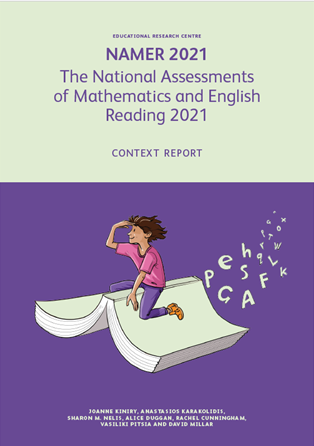
The National Assessments of Mathematics and English Reading and 2021: Context Report​

DOI: https://doi.org/10.70092/1413183.0325

Authors: Joanne Kiniry, Anastasios Karakolidis, Sharon M. Nelis, Alice Duggan, Rachel Cunningham, Vasiliki Pitsia and David Millar​

Title: The National Assessments of Mathematics and English Reading and 2021: Context Report​

Abstract:

The 2021 National Assessments of English Reading and Mathematics (NAMER) Context Report offers a comprehensive analysis of the factors influencing achievement in Second class English reading and Sixth class maths in Ireland. Due to pandemic-related disruptions, NAMER 2021 was postponed from 2020 and adapted to reduce the testing burden. Pupils had experienced approximately two months of remote teaching prior to returning to face-to-face instruction in March 2021.

Drawing on data from questionnaires administered to pupils, teachers, and school principals, this report situates performance outcomes within broader educational and socio-economic settings. Key variables examined include, pupil background, language, instructional time and homework, teacher professional development, digital practices in school and home, and school factors such as school gender, planning and COVID-19 impact.

Recommendations stress the need to build on existing good practice in schools as well as the strengthening initiatives to improve liking and confidence in reading and mathematics.

[Download Report]

Publication date: 25th April 2025

ERC publishes Strategic Plan for 2025-2030

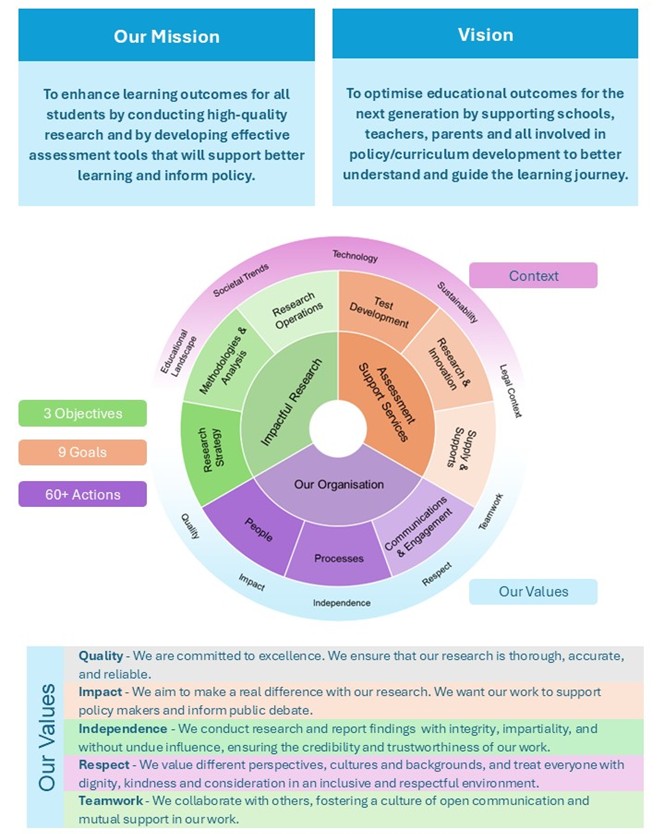
The ERC has published its Strategic Plan for 2025-2030, a blueprint that will guide the organisation through the next phase of growth, innovation, and impact in the fields of education and research in Ireland. This plan builds on the ERC’s almost 60-year history of producing evidence-based research insights and high-quality assessment support services that facilitate the improvement of educational practices and policies.

This strategic plan outlines a vision to not only sustain but to elevate the role of the ERC. We aim to do more, engage further, and strengthen the impact of our work. Our five-year goals are ambitious, and rightly so. They are designed to position the ERC as a leader in educational research, while comprehensively supporting Ireland’s educational community with actionable insights and innovative assessment support services.
The strategic plan is the result of wide consultation with educators, researchers, policymakers, and learners, and reflects the ERC’s evolving role as a national leader in educational evidence and evaluation.

The full plan is now available here: English Version and Irish Version (FTO Plean Straitéiseach_2025-2030)

ERC publishes Strategic Plan for 2025-2030

The ERC has published its Strategic Plan for 2025-2030, a blueprint that will guide the organisation through the next phase of growth, innovation, and impact in the fields of education and research in Ireland. This plan builds on the ERC’s almost 60-year history of producing evidence-based research insights and high-quality assessment support services that facilitate the improvement of educational practices and policies.

This strategic plan outlines a vision to not only sustain but to elevate the role of the ERC. We aim to do more, engage further, and strengthen the impact of our work. Our five-year goals are ambitious, and rightly so. They are designed to position the ERC as a leader in educational research, while comprehensively supporting Ireland’s educational community with actionable insights and innovative assessment support services.
The strategic plan is the result of wide consultation with educators, researchers, policymakers, and learners, and reflects the ERC’s evolving role as a national leader in educational evidence and evaluation.

Eolas ón ERC – April 2025 Newsletter

You can read the ERC’s April 2025 Newsletter here.

This newsletter includes information on:

  • The ERC Drumcondra Tests
  • The benefits of online testing via DOTS
  • ERC’s redevelopment of its Irish langauge tests
  • Exemptions and Reasonable Accommodations

ERC commences development of new versions of Drumcondra Tests for Irish Language

The ERC is pleased to announce that we have commenced the redevelopment of our two primary-level Irish language standardised tests, which are used in Irish-medium and English-medium primary schools across Ireland. 

The current tests (Triail Ghaeilge Dhroim Conrach do Bhunscoileanna Gaeltachta agus Lán-Ghaeilge (TGD-G) and Triail Ghaeilge Dhroim Conrach do Scoileanna Rialta (TGD-R)), which have been a cornerstone of language assessment of students for the past 15 years, are being comprehensively reviewed and renormed to better reflect current educational needs and practices, and up-to-date standards of Irish among children nationally. The current versions of TGD-G and TGD-R continue to provide a valuable tool for assessing Irish in schools.

The redevelopment of these standardised tests over the coming three years marks a significant step in ensuring that language assessment tools remain accurate, effective and relevant. The existing tests, which have provided invaluable data to support language learning and teaching, will be thoroughly reviewed and modernised. This process will involve collaboration with language experts, educators, and other stakeholders to ensure that the new assessments meet the highest standards of validity and reliability.

The ERC recognise the importance of providing up-to-date and robust assessment tools that reflect the evolving landscape of language education. The redevelopment of these Irish language tests will support schools in effectively evaluating language proficiency and guiding language instruction.

The new tests will aim to accommodate diverse learning contexts and will be designed to better align with current curricular objectives and linguistic research, fostering a more comprehensive understanding of students’ language abilities. Both paper and online versions of the tests will be developed by the ERC.

The ERC remains committed to supporting Irish language education through ongoing research and innovation. Further updates on the redevelopment process will be shared as the project progresses.

ERC commences development of new versions of Drumcondra Tests for Irish Language

The ERC is pleased to announce that we have commenced the redevelopment of our two primary-level Irish language standardised tests, which are used in Irish-medium and English-medium primary schools across Ireland. 

The current tests (Triail Ghaeilge Dhroim Conrach do Bhunscoileanna Gaeltachta agus Lán-Ghaeilge (TGD-G) and Triail Ghaeilge Dhroim Conrach do Scoileanna Rialta (TGD-R)), which have been a cornerstone of language assessment of students for the past 15 years, are being comprehensively reviewed and renormed to better reflect current educational needs and practices, and up-to-date standards of Irish among children nationally. The current versions of TGD-G and TGD-R continue to provide a valuable tool for assessing Irish in schools.

The redevelopment of these standardised tests over the coming three years marks a significant step in ensuring that language assessment tools remain accurate, effective and relevant. The existing tests, which have provided invaluable data to support language learning and teaching, will be thoroughly reviewed and modernised. This process will involve collaboration with language experts, educators, and other stakeholders to ensure that the new assessments meet the highest standards of validity and reliability.

The ERC recognise the importance of providing up-to-date and robust assessment tools that reflect the evolving landscape of language education. The redevelopment of these Irish language tests will support schools in effectively evaluating language proficiency and guiding language instruction.

The new tests will aim to accommodate diverse learning contexts and will be designed to better align with current curricular objectives and linguistic research, fostering a more comprehensive understanding of students’ language abilities. Both paper and online versions of the tests will be developed by the ERC.

The ERC remains committed to supporting Irish language education through ongoing research and innovation. Further updates on the redevelopment process will be shared as the project progresses.

This site is registered on wpml.org as a development site. Switch to a production site key to remove this banner.