The home learning environment of students in Ireland: New findings from TIMSS 2023

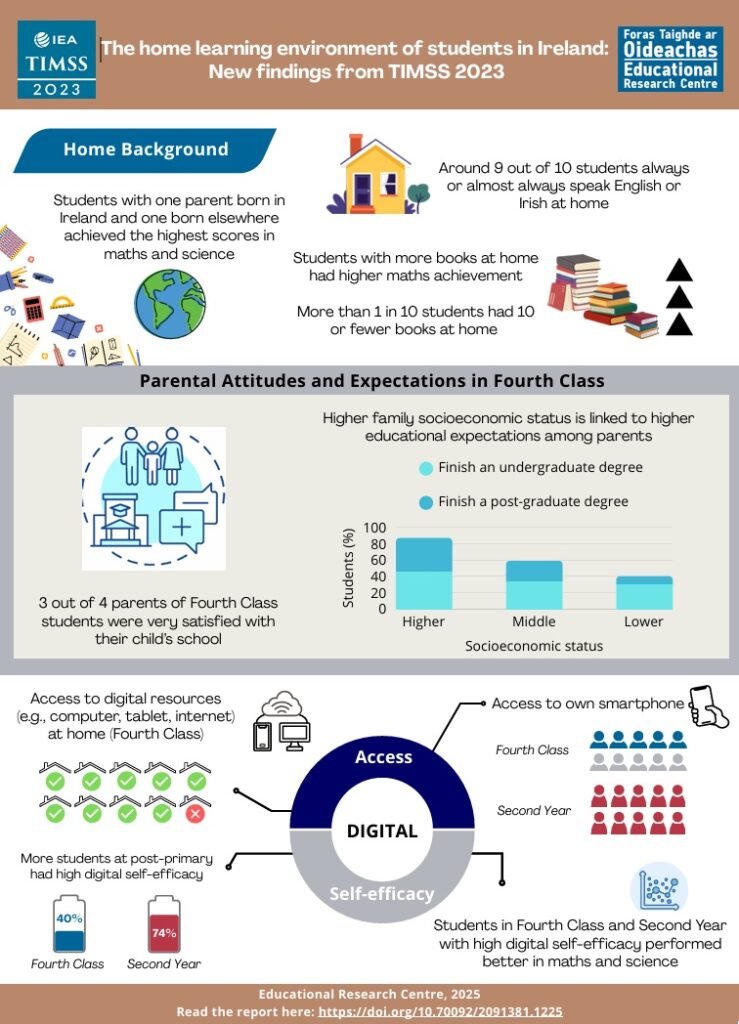
This report focuses on the home learning environment of Fourth Class and Second Year students in Ireland using data from TIMSS (Trends in International Mathematics and Science Study) 2023. It describes findings about students’ socioeconomic status, the availability of selected home resources for learning and home possessions, digital resources at home and use of digital resources for learning, parental education and occupation, home language, early childhood learning and skills, and the attitudes and expectations towards education of parents and students. These data are examined at a nationally representative level and for key subgroups of students: by gender, socioeconomic status, and school DEIS (Delivering Equality of Opportunity in Schoolsstatus. Implications for policymakers in the Irish national context are discussed.

Continuity and change in Ireland’s schools and classrooms: TIMSS 2011–2023

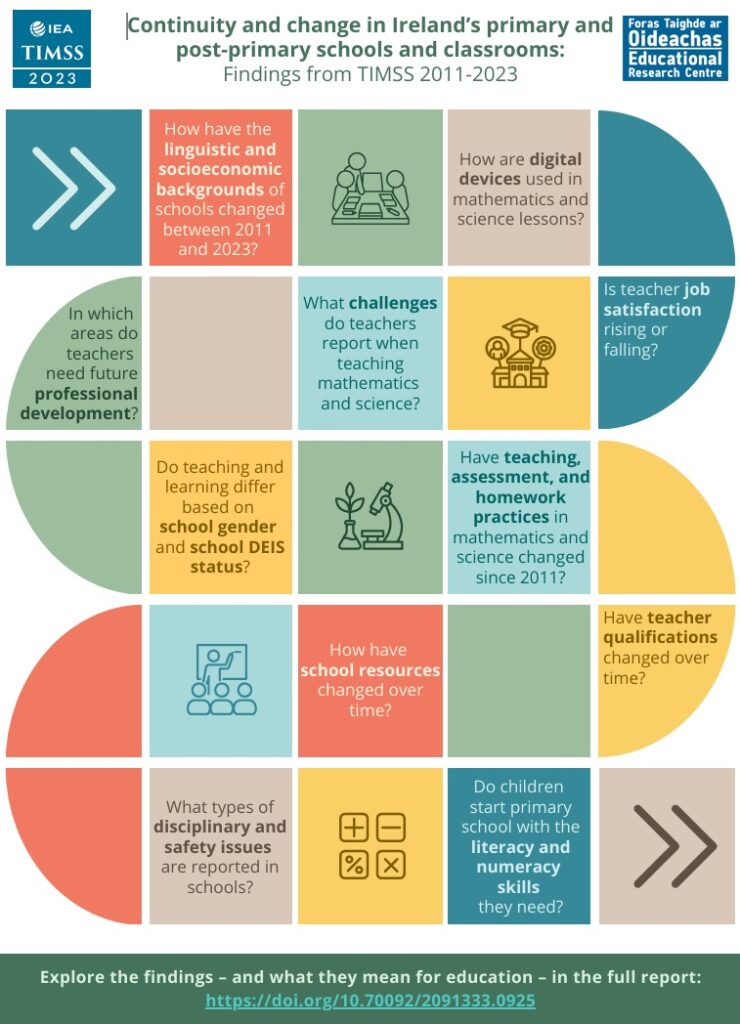
This report provides a comprehensive analysis of developments in schools, classrooms, and the teaching and learning of mathematics and science at primary and post-primary levels in Ireland between 2011 and 2023. Drawing on data from the Trends in International Mathematics and Science Study (TIMSS), collected from students, teachers, and school principals, the report examines trends in school composition, resources, and learning environments. It also explores the organisation and delivery of mathematics and science instruction, assessment practices, instructional challenges, and the integration of digital devices in teaching and learning. These findings are contextualised within national education policies and initiatives, highlighting how Ireland’s education system has adapted to changing pedagogical, technological, and societal expectations. By tracing patterns of continuity and change, the report provides valuable insights into the evolving educational landscape and provides a robust evidence base to inform future policy, practice, and evaluation in mathematics and science education.

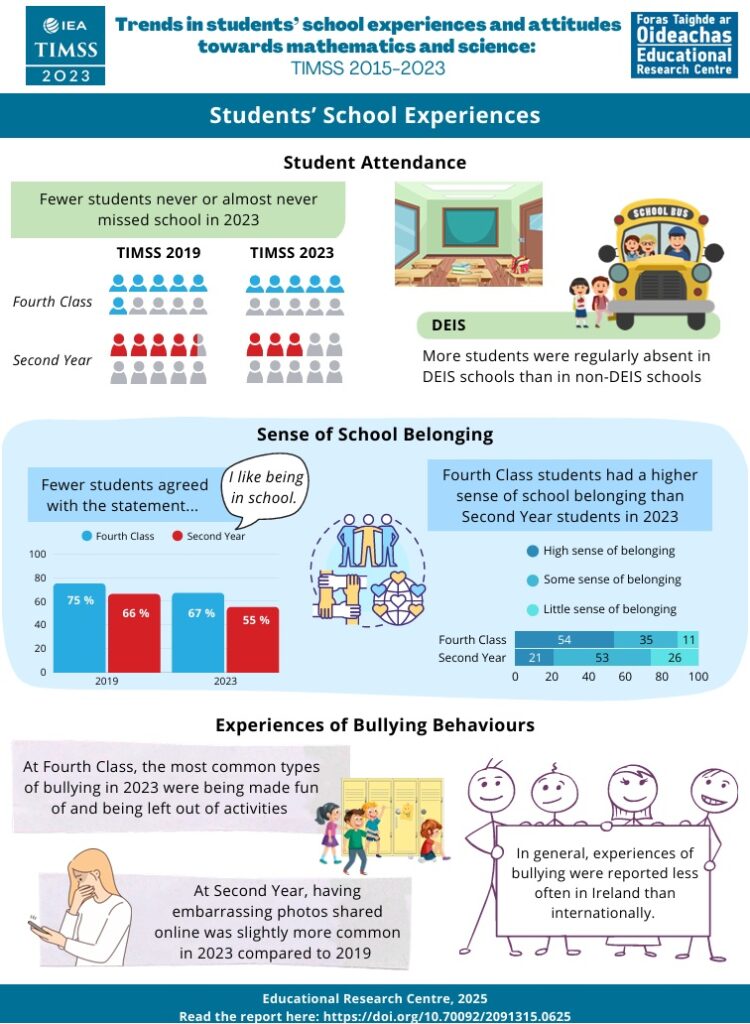
Trends in students’ school experiences and attitudes towards mathematics and science: TIMSS 2015–2023

This report describes the school experiences and attitudes of Fourth Class and Second Year students in Ireland. Drawing on data from the 2023 cycle of the Trends in International Mathematics and Science Study (TIMSS), it delves into the experiences of students in relation to their attendance at school, sense of belonging, and experiences of bullying. Also discussed in the report are students’ attitudes towards mathematics and science; in particular, the extent to which students like learning, feel confident, and value mathematics and science. A key feature of this report is that it examines trends in students’ experiences and attitudes across the three most recent cycles of TIMSS (2015, 2019 and 2023). The findings point towards some noteworthy changes in Irish students’ experiences and attitudes over time. Finally, some conclusions and implications for policymakers in Ireland are outlined.

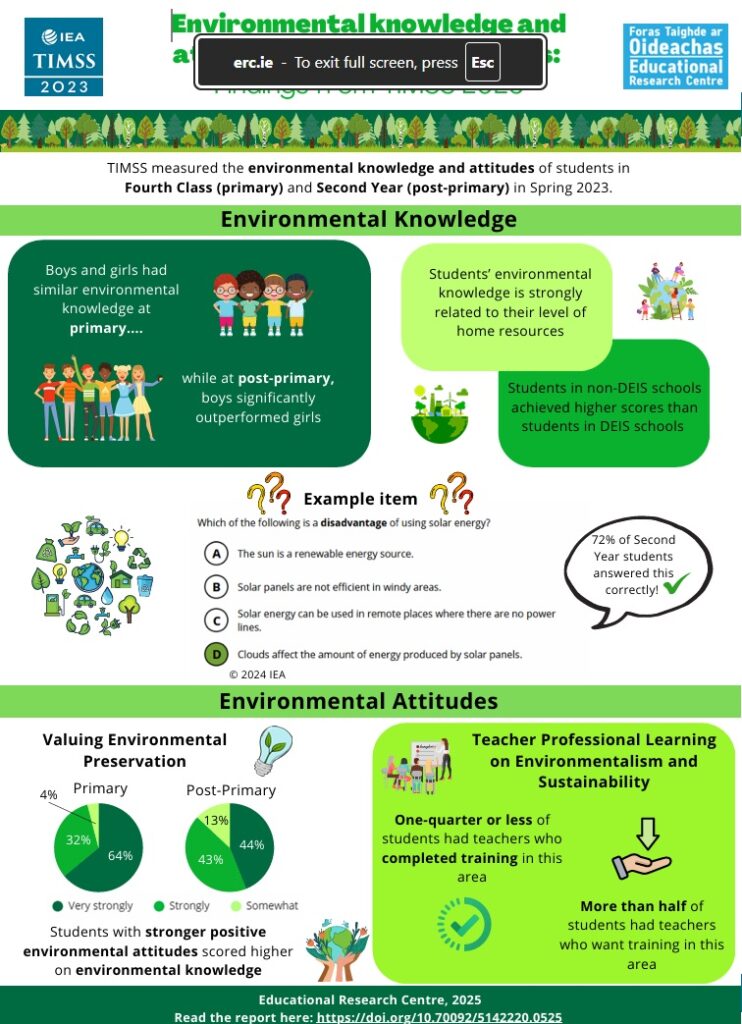
Environmental knowledge and attitudes in Ireland’s schools: Findings from TIMSS 2023

This report presents findings for Ireland for two aspects of students’ environmental awareness that were captured for the first time in the 2023 cycle of TIMSS (Trends in International Mathematics and Science Study). These are (i) students’ environmental knowledge – a subscale of the science assessment, drawing on selected items that are related to environmental and climate issues – and (ii) students’ attitudes towards environmental preservation. The report presents data for Fourth Class (primary) and Second Year (post-primary) students, and also describes environmentally relevant practices and attitudes of their parents, teachers, and principals, as recorded via questionnaires. The findings, which are novel in an Irish context, are discussed with reference to the broader national policy context of environmental awareness in schools.

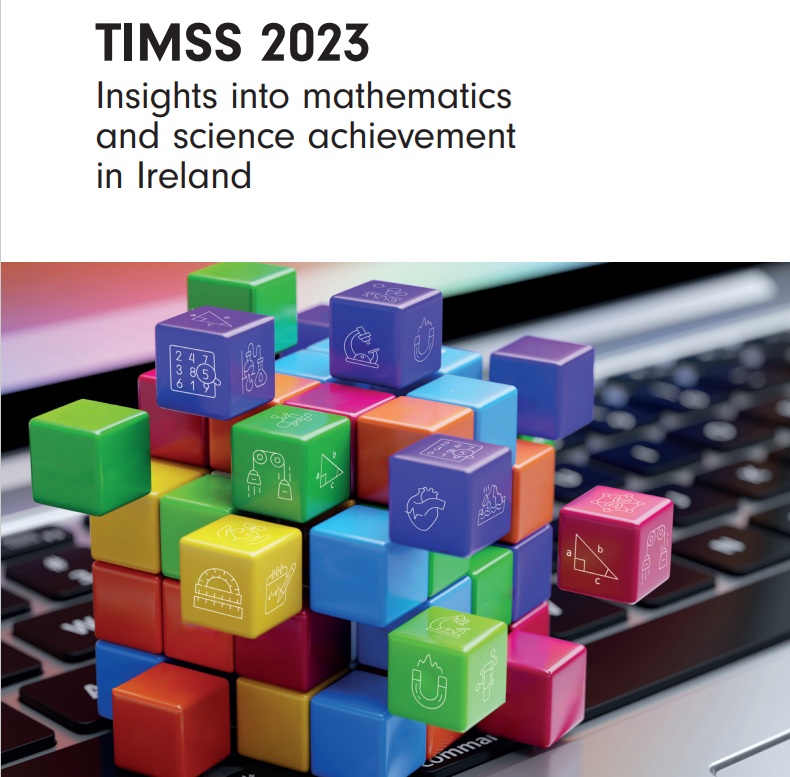
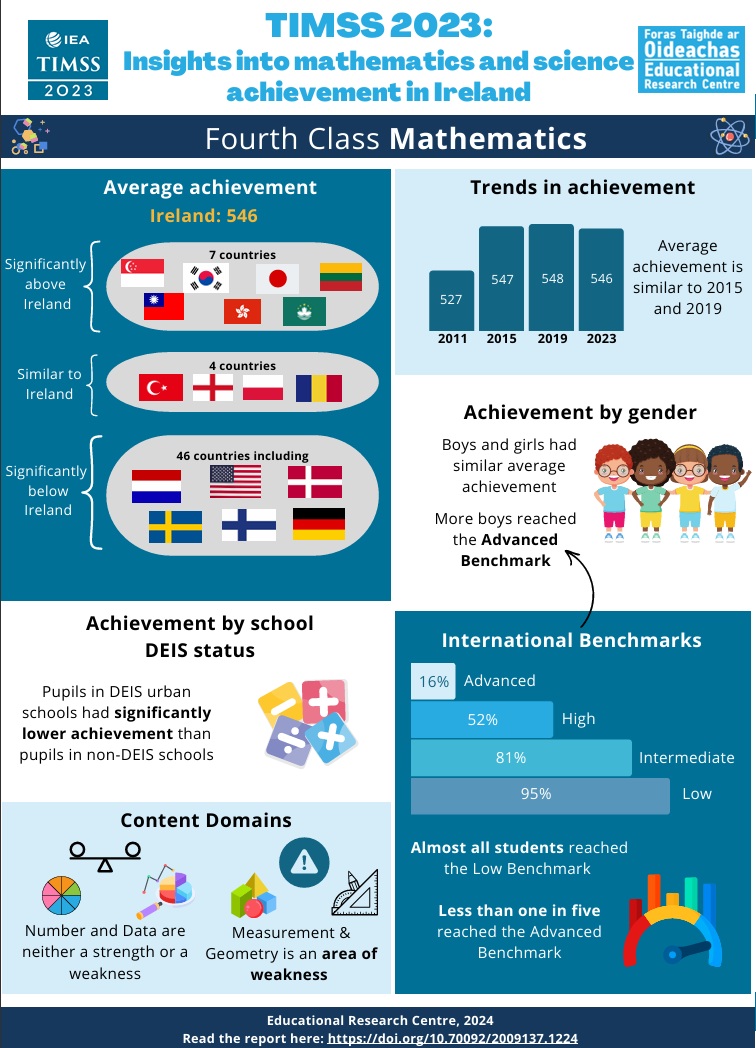
TIMSS 2023: Insights into mathematics and science achievement in Ireland

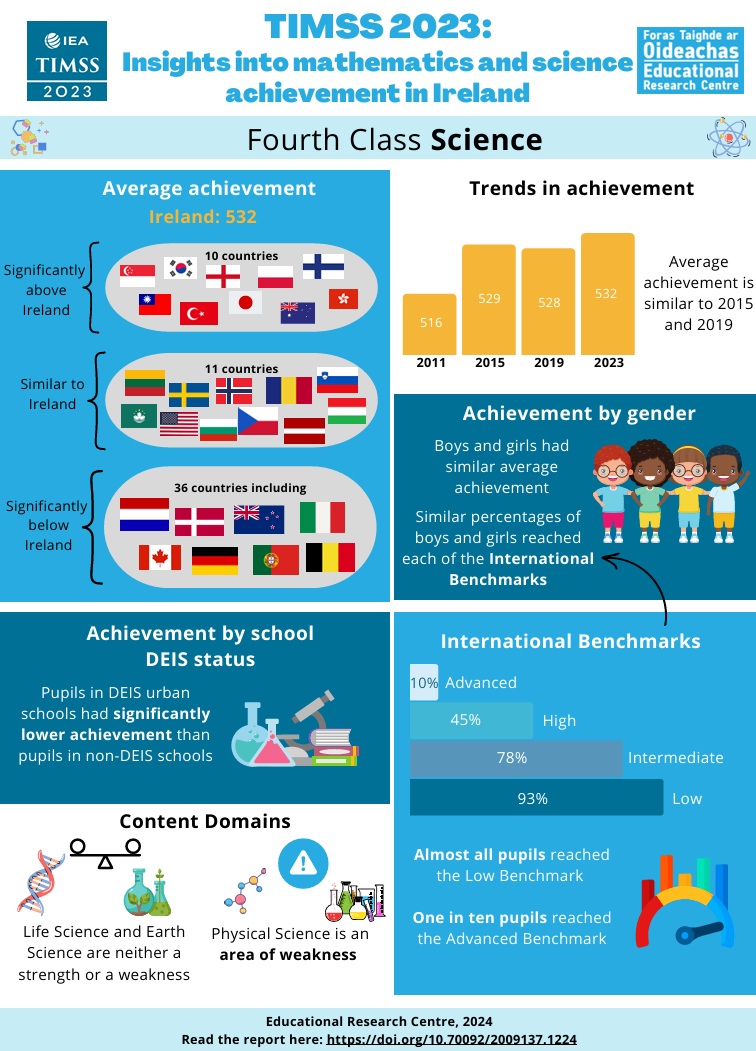
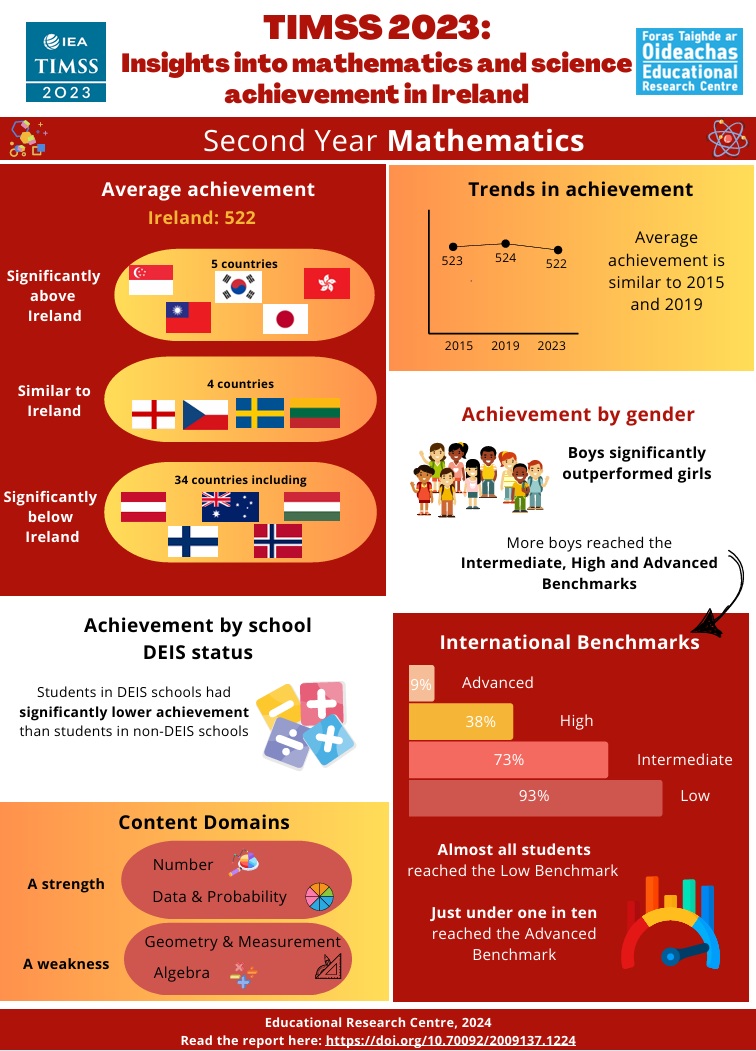
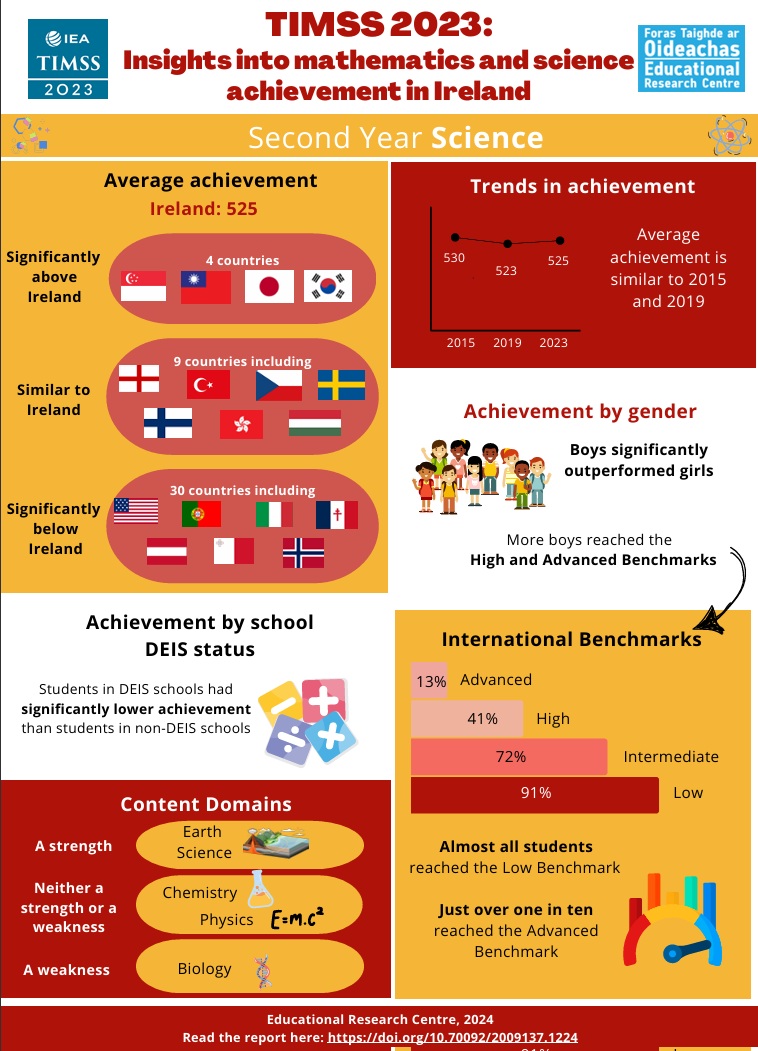
This report presents the achievement results for Ireland in the Trends in International Mathematics and Science Study (TIMSS) 2023. TIMSS assesses the mathematical and scientific knowledge and skills of students in Fourth Grade and Eighth Grade (Fourth Class and Second Year in Ireland). TIMSS is a study of the International Association for the Evaluation of Educational Achievement (IEA) and has been conducted every four years since 1995. TIMSS 2023 is the eighth cycle of the study and included 656,360 students from 65 countries.

This national report focuses on trends in overall achievement in Ireland, as well as the distribution of achievement (performance at various percentiles), student performance at the TIMSS International Benchmarks, relative strengths and weaknesses on the TIMSS content and cognitive domains, and teachers’ reports of curriculum coverage. Performance in Ireland is explored in the context of selected countries; compared with previous cycles of TIMSS where data are available (since 2011 for Fourth Class and since 2015 for Second Year); and, where applicable, examined by gender and by socioeconomic status at both individual level and at school level (DEIS status).

TIMSS 2023 also marks Ireland’s transition from paper-based to digital testing, as part of which Ireland completed a national mode effect study to examine the extent to which any differences in student achievement exist between digital and paper testing. Initial findings from this mode effect study are also presented.

Finally, some conclusions and implications for policymakers in Ireland are outlined.

Digital Learning Framework (DLF) national longitudinal evaluation: Wave 2 Final Report.

This is the final report on the Digital Learning Framework national longitudinal evaluation, following data collection for Wave 2 from Autumn 2021-May 2022. The data presented in this report provide an opportunity to consider how schools and students responded to the challenges of the COVID-19 pandemic with reference to the use of digital technologies for teaching, learning and assessment. The evaluation also considers the ways in which schools have had successes and met challenges in their embedding and implementation of the Department of Education’s Digital learning Framework. The report provides an overview of the current policy and research landscape with respect to the use of digital technologies in schools and over the course of the pandemic. It also presents new data at both primary and post-primary levels from schools (digital learning team leaders, school principals, and teachers), students, and professional development advisors specialising in the use of technology in education. The key findings from Wave 2 of the evaluation are highlighted, together with examination of changes from previous waves. Finally, the main successes and challenges encountered by schools in their implementation of the Digital Learning Framework over the period 2017-2022 are identified.

Final report of the longitudinal Digital Learning Framework Evaluation

This is the final report on the Digital Learning Framework national longitudinal evaluation, following data collection for Wave 2 from Autumn 2021-May 2022. The data presented in this report provide an opportunity to consider how schools and students responded to the challenges of the COVID-19 pandemic with reference to the use of digital technologies for teaching, learning and assessment. The evaluation also considers the ways in which schools have had successes and met challenges in their embedding and implementation of the Department of Education’s Digital learning Framework. The report provides an overview of the current policy and research landscape with respect to the use of digital technologies in schools and over the course of the pandemic. It also presents new data at both primary and post-primary levels from schools (digital learning team leaders, school principals, and teachers), students, and professional development advisors specialising in the use of technology in education. The key findings from Wave 2 of the evaluation are highlighted, together with examination of changes from previous waves. Finally, the main successes and challenges encountered by schools in their implementation of the Digital Learning Framework over the period 2017-2022 are identified

An in-depth analysis of the relative strengths and weaknesses of students in Ireland in mathematics and science in TIMSS 2019

TIMSS 2019: Ireland’s results in mathematics and science

Students’ perspectives on learning mathematics and science: Results from TIMSS 2015 in Ireland

The home learning environment in Ireland: Insights from TIMSS 2015

National Schools, international contexts: Beyond the PIRLS and TIMSS 2011 test results

PIRLS and TIMSS 2011: Technical report for Ireland

PIRLS & TIMSS 2011: Reading, mathematics and science outcomes for Ireland