The home learning environment of students in Ireland: New findings from TIMSS 2023

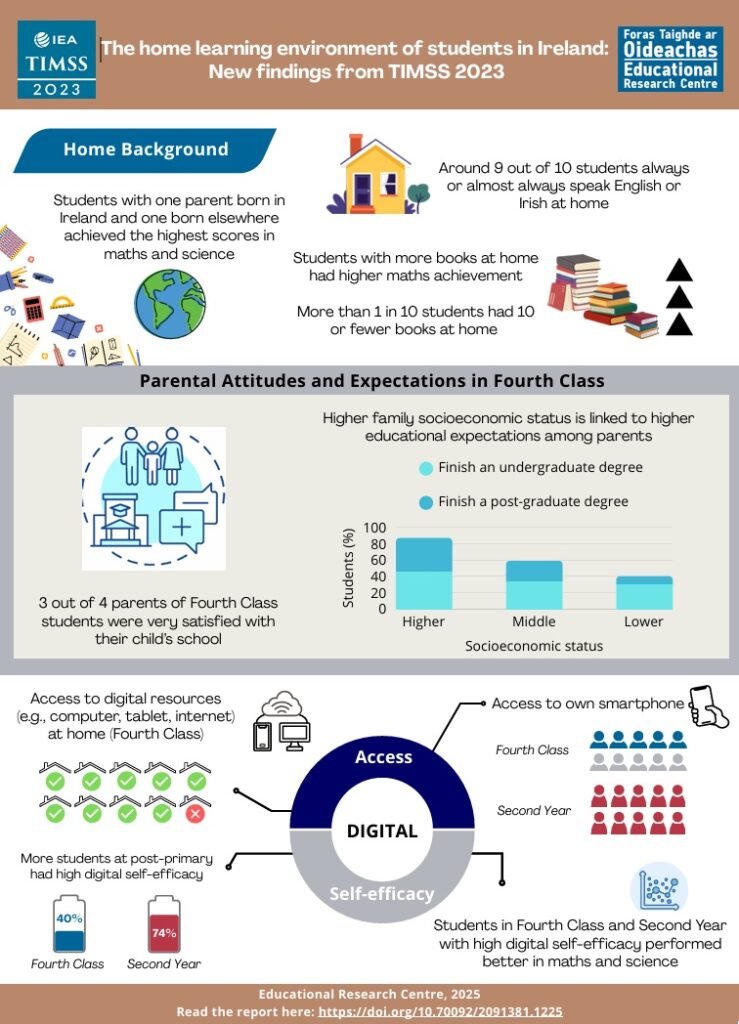
This report focuses on the home learning environment of Fourth Class and Second Year students in Ireland using data from TIMSS (Trends in International Mathematics and Science Study) 2023. It describes findings about students’ socioeconomic status, the availability of selected home resources for learning and home possessions, digital resources at home and use of digital resources for learning, parental education and occupation, home language, early childhood learning and skills, and the attitudes and expectations towards education of parents and students. These data are examined at a nationally representative level and for key subgroups of students: by gender, socioeconomic status, and school DEIS (Delivering Equality of Opportunity in Schoolsstatus. Implications for policymakers in the Irish national context are discussed.

Infographic


Continuity and change in Ireland’s schools and classrooms: TIMSS 2011–2023

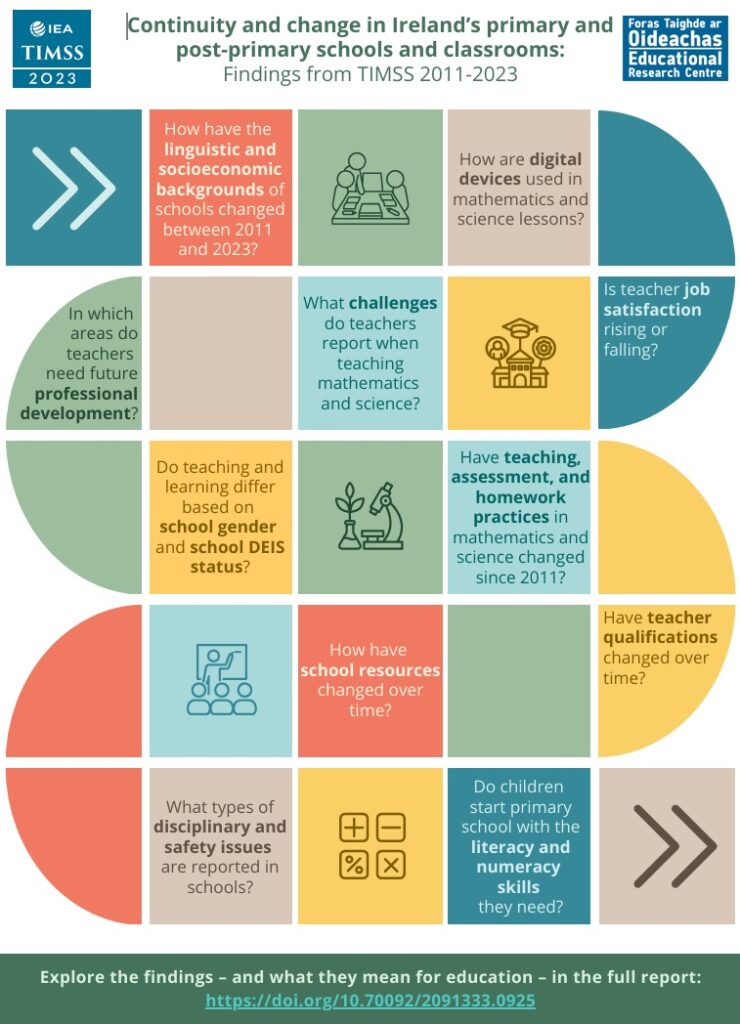
This report provides a comprehensive analysis of developments in schools, classrooms, and the teaching and learning of mathematics and science at primary and post-primary levels in Ireland between 2011 and 2023. Drawing on data from the Trends in International Mathematics and Science Study (TIMSS), collected from students, teachers, and school principals, the report examines trends in school composition, resources, and learning environments. It also explores the organisation and delivery of mathematics and science instruction, assessment practices, instructional challenges, and the integration of digital devices in teaching and learning. These findings are contextualised within national education policies and initiatives, highlighting how Ireland’s education system has adapted to changing pedagogical, technological, and societal expectations. By tracing patterns of continuity and change, the report provides valuable insights into the evolving educational landscape and provides a robust evidence base to inform future policy, practice, and evaluation in mathematics and science education.

e-Appendices associated with this publication: Chapter 2, Chapter 3, Chapter 4, Chapter 5, Chapter 6


Infographic

Trends in students’ school experiences and attitudes towards mathematics and science: TIMSS 2015–2023

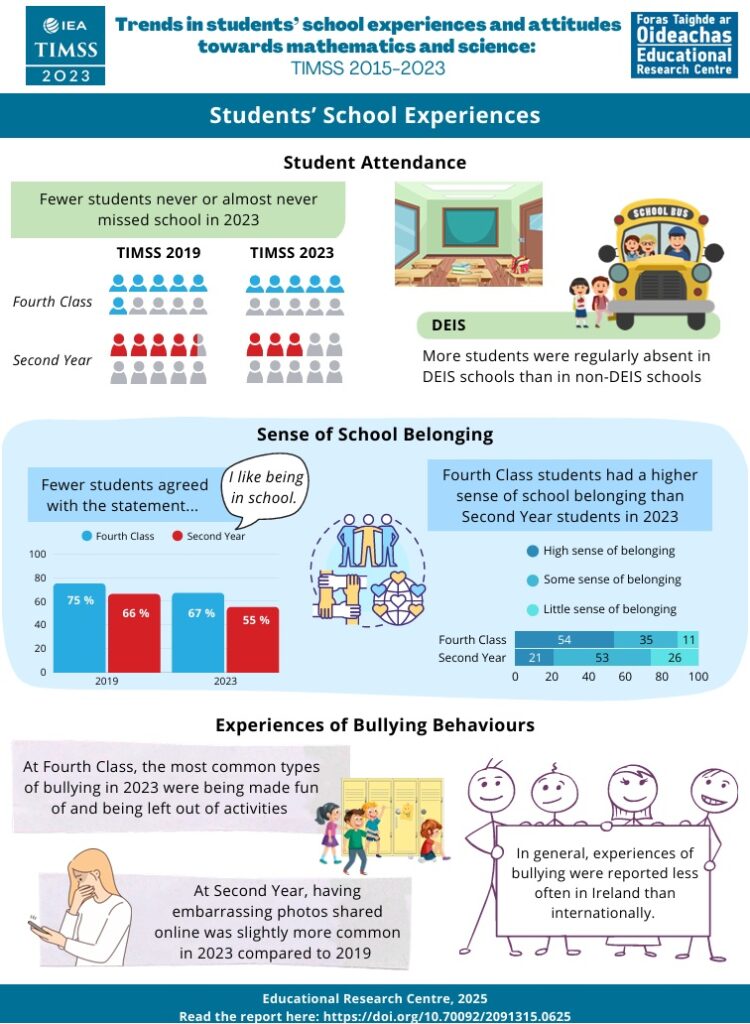
This report describes the school experiences and attitudes of Fourth Class and Second Year students in Ireland. Drawing on data from the 2023 cycle of the Trends in International Mathematics and Science Study (TIMSS), it delves into the experiences of students in relation to their attendance at school, sense of belonging, and experiences of bullying. Also discussed in the report are students’ attitudes towards mathematics and science; in particular, the extent to which students like learning, feel confident, and value mathematics and science. A key feature of this report is that it examines trends in students’ experiences and attitudes across the three most recent cycles of TIMSS (2015, 2019 and 2023). The findings point towards some noteworthy changes in Irish students’ experiences and attitudes over time. Finally, some conclusions and implications for policymakers in Ireland are outlined.

Infographic

Environmental knowledge and attitudes in Ireland’s schools: Findings from TIMSS 2023

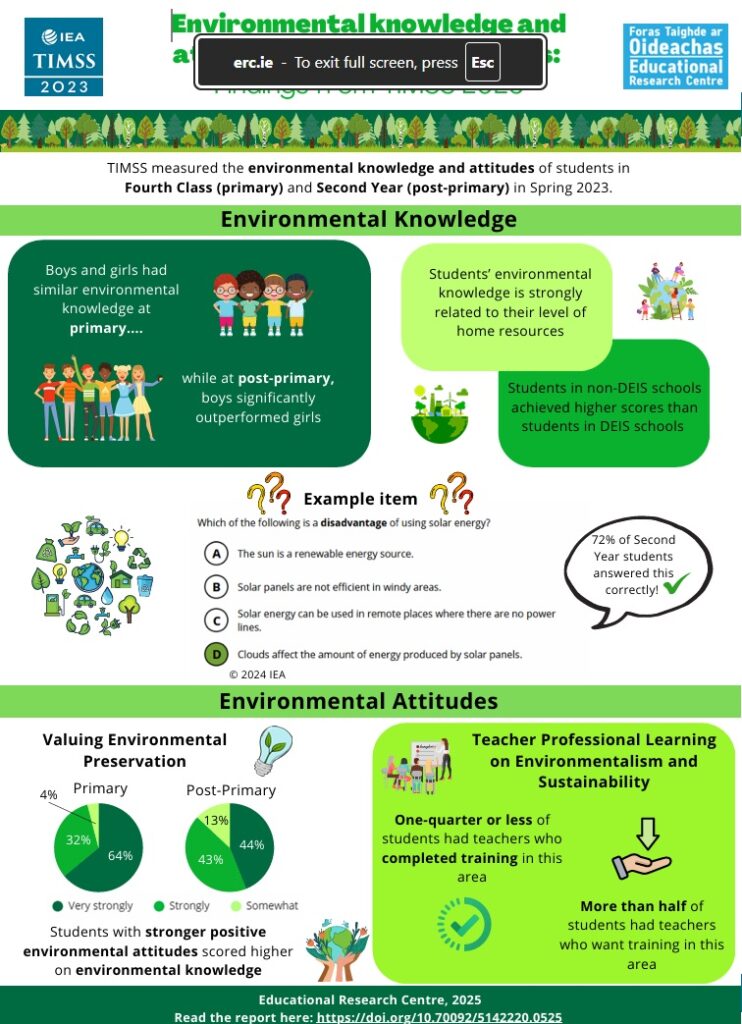
This report presents findings for Ireland for two aspects of students’ environmental awareness that were captured for the first time in the 2023 cycle of TIMSS (Trends in International Mathematics and Science Study). These are (i) students’ environmental knowledge – a subscale of the science assessment, drawing on selected items that are related to environmental and climate issues – and (ii) students’ attitudes towards environmental preservation. The report presents data for Fourth Class (primary) and Second Year (post-primary) students, and also describes environmentally relevant practices and attitudes of their parents, teachers, and principals, as recorded via questionnaires. The findings, which are novel in an Irish context, are discussed with reference to the broader national policy context of environmental awareness in schools.

Infographic

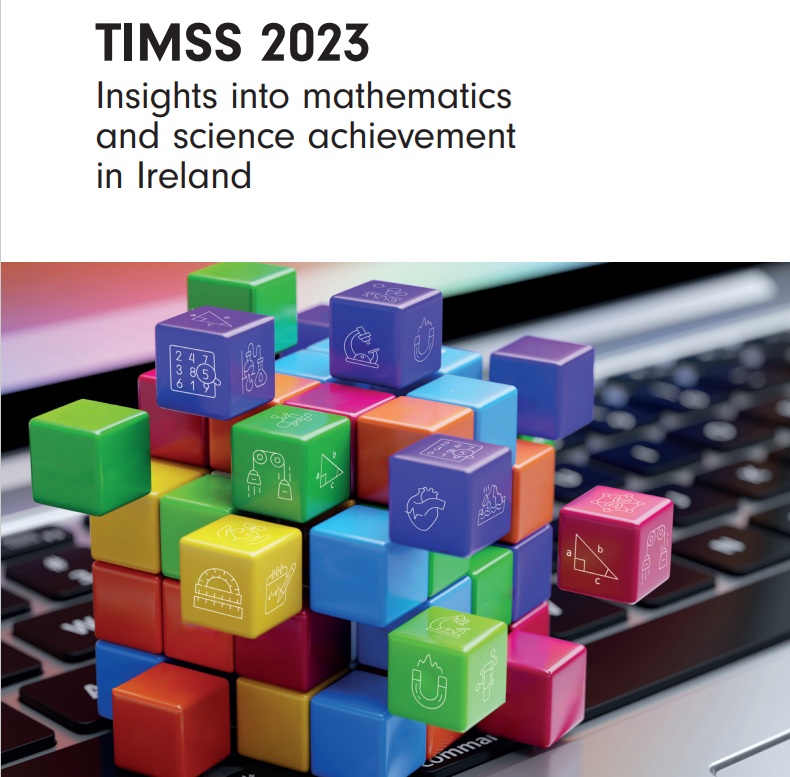
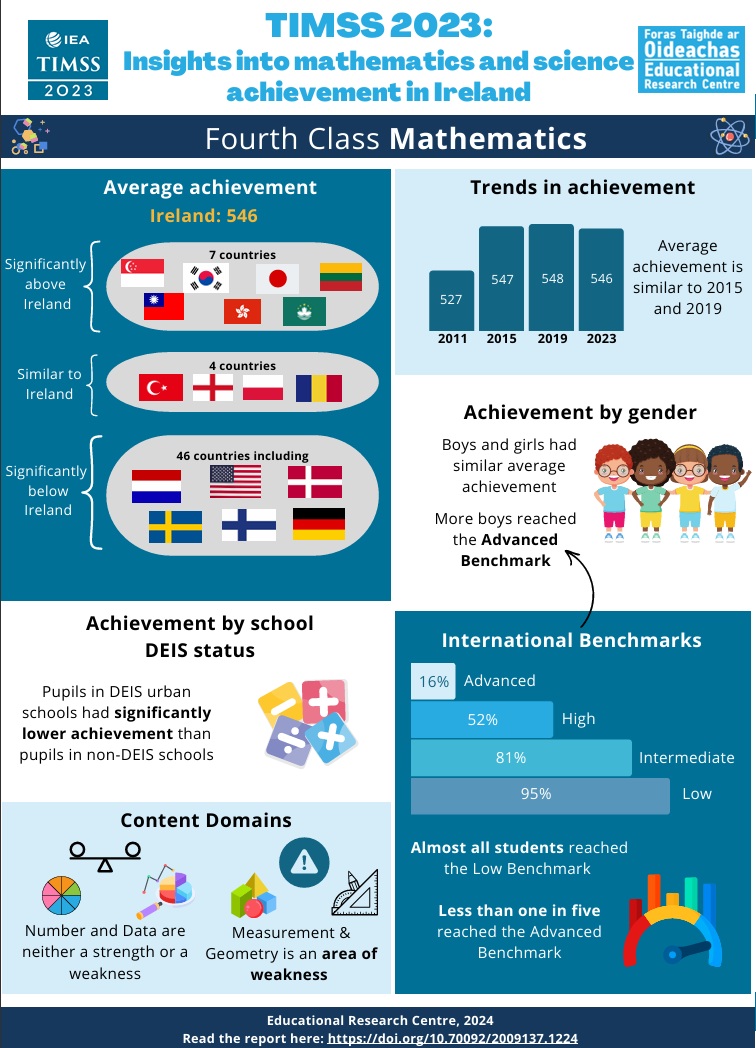
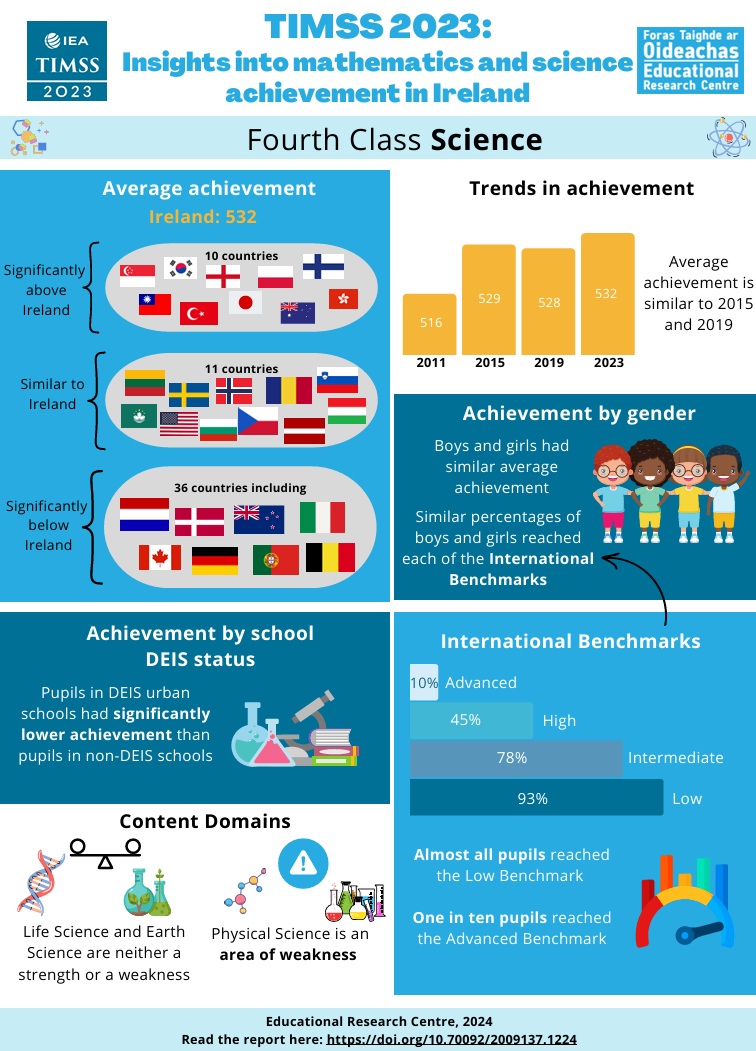
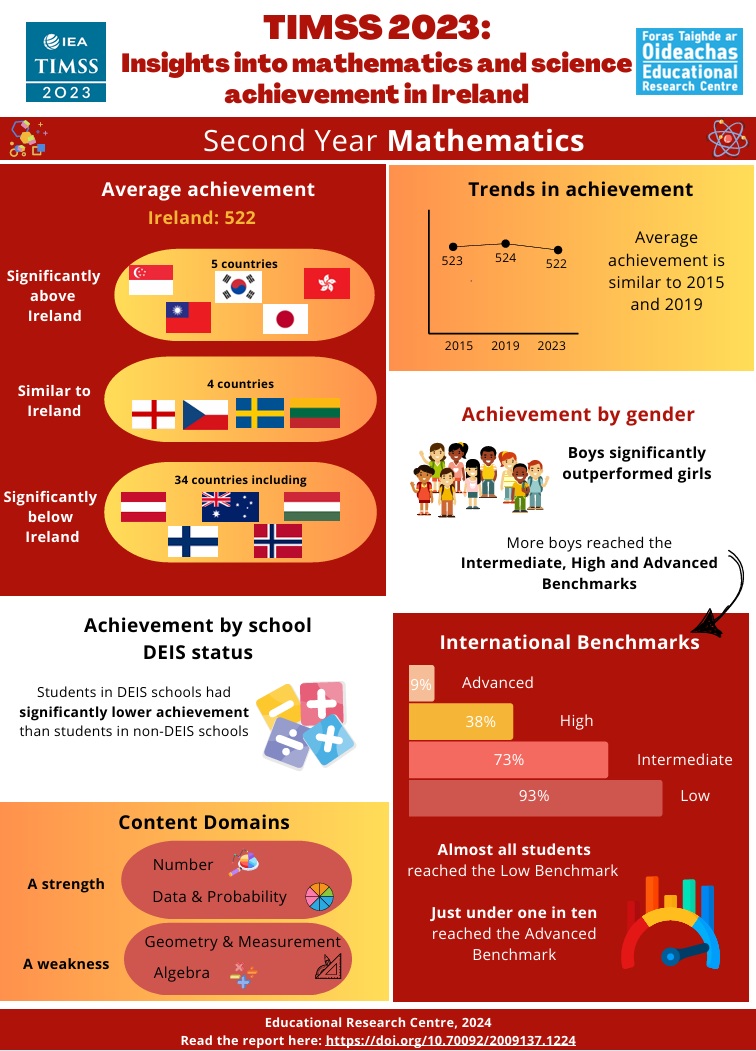
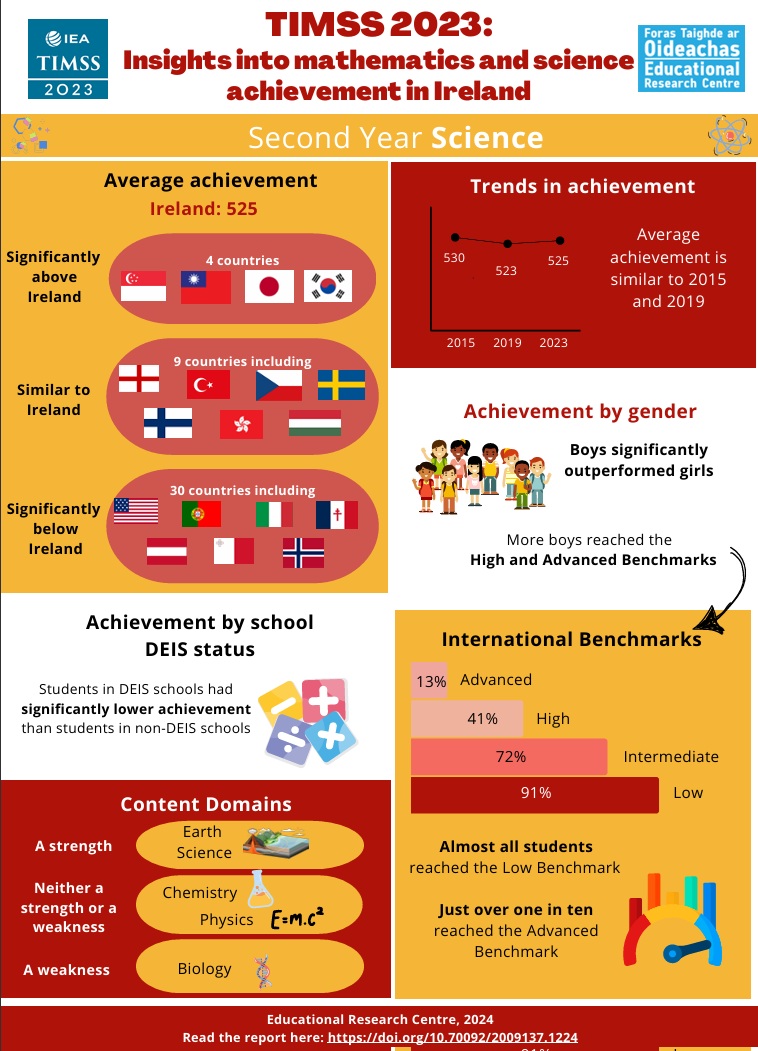
TIMSS 2023: Insights into mathematics and science achievement in Ireland

This report presents the achievement results for Ireland in the Trends in International Mathematics and Science Study (TIMSS) 2023. TIMSS assesses the mathematical and scientific knowledge and skills of students in Fourth Grade and Eighth Grade (Fourth Class and Second Year in Ireland). TIMSS is a study of the International Association for the Evaluation of Educational Achievement (IEA) and has been conducted every four years since 1995. TIMSS 2023 is the eighth cycle of the study and included 656,360 students from 65 countries.

This national report focuses on trends in overall achievement in Ireland, as well as the distribution of achievement (performance at various percentiles), student performance at the TIMSS International Benchmarks, relative strengths and weaknesses on the TIMSS content and cognitive domains, and teachers’ reports of curriculum coverage. Performance in Ireland is explored in the context of selected countries; compared with previous cycles of TIMSS where data are available (since 2011 for Fourth Class and since 2015 for Second Year); and, where applicable, examined by gender and by socioeconomic status at both individual level and at school level (DEIS status).

TIMSS 2023 also marks Ireland’s transition from paper-based to digital testing, as part of which Ireland completed a national mode effect study to examine the extent to which any differences in student achievement exist between digital and paper testing. Initial findings from this mode effect study are also presented.

Finally, some conclusions and implications for policymakers in Ireland are outlined.

e-Appendix associated with this publication – download

Infographics

An in-depth analysis of the relative strengths and weaknesses of students in Ireland in mathematics and science in TIMSS 2019

This report is aimed at informing the work of teachers, school leaders, teacher educators, and curriculum developers in Ireland. It describes in detail the performance of Fourth Class (primary) and Second Year (post-primary) students on a range of mathematics and science topics and test items. In interpreting the data presented here from the TIMSS 2019 study (the Trends in International Mathematics and Science Study), students’ performance is discussed with reference to relevant aspects of the Irish curricula for mathematics and science, and to international comparisons of student performance.

The findings presented here build on the initial national report on TIMSS 2019 (Perkins & Clerkin, 2020), which described student performance in mathematics and science in terms of average achievement, distributions of achievement among higher- and lower-achieving students, gender differences, benchmarks of performance (Low, Intermediate, High, or Advanced), and high-level
descriptions of performance on the TIMSS cognitive and content domains. This report expands on the latter aspect by providing a detailed examination of Fourth Class and Second Year students’ performance on the TIMSS content domains and, in particular, on their constituent subdomains and topic areas.

Associated e-appendices


Flyers

Strengths and Weaknesses in Maths and Science at Fourth Class

Strengths and Weaknesses in Maths and Science at Second Year

Trends in educational inequalities in Ireland’s primary schools: an analysis based on TIMSS data (2011-2019).

Published in:  Large Scale Assessments in Education


Abstract:

Background

Socioeconomic characteristics are persistently and systematically related to academic outcomes, despite long-standing efforts to reduce educational inequality. Ireland has a strong policy focus on alleviating educational disadvantage and has seen significant improvements in mathematics and science performance in recent years. This study investigates patterns of socioeconomic inequalities in 4th grade students’ performance in mathematics and science between 2011 and 2019. Two measures of inequality are examined: (i) inequality of achievement, i.e., the degree of variability in student performance and (ii) inequality of opportunity, i.e., the extent to which student performance is related to background characteristics.

Methods

Data for 4th-grade students in Ireland from TIMSS 2011, TIMSS 2015 and TIMSS 2019 were used. Mathematics and science achievement were the main outcome measures. The home resources for learning index was used as a proxy for student-level socioeconomic status. School-level socioeconomic status was examined according to schools’ participation in the Delivering Equality of Opportunity in Schools (DEIS) programme, which is the Department of Education’s main policy initiative addressing educational disadvantage. Descriptive and multilevel regression analyses were conducted to explore variability in student performance and to investigate the variance in achievement explained by socioeconomic factors, across cycles and subjects.

Results

Between 2011 and 2015, between-student and between-school differences in mathematics and science performance became smaller, as shown by the decrease in standard deviations and the intraclass correlation coefficients (ICCs). This points to reduced inequality of achievement. Between 2015 and 2019, a small increase in inequality of achievement was observed.

Regarding inequality of opportunity, students’ home resources for learning and school disadvantaged status were statistically significantly related to mathematics and science achievement across all three cycles. Overall variance explained by these two variables increased from 2011 to 2019. This points towards increasing inequality of opportunity over the period examined.

Performance gaps between disadvantaged and non-disadvantaged schools have been reduced over time; however, the relationship between home resources for learning and achievement appears to have strengthened. Findings were consistent for both subjects.

Conclusions

The findings indicate that improvements in overall performance do not necessarily reflect improved equality. Ireland’s improvements in average mathematics and science performance between 2011 and 2015 were accompanied by reduced inequality of achievement. Performance differences between disadvantaged and non-disadvantaged schools have been reduced over time, suggesting that the DEIS policy is meeting its goal of narrowing achievement gaps based on concentrations of educational disadvantage. However, inequality of opportunity linked to student-level socioeconomic factors (i.e., home resources for learning) appears to have increased over time. These findings are valuable in the context of measuring and tracking educational inequalities.

Duggan, A., Karakolidis, A., Clerkin, A., Gilleece, L., & Perkins, R. (2023). Trends in educational inequalities in Ireland’s primary schools: an analysis based on TIMSS data (2011-2019). Large Scale Assessments in Education, 11(39). https://doi.org/10.1186/s40536-023-00188-2

TIMSS 2019: Ireland’s results in mathematics and science

Students’ perspectives on learning mathematics and science: Results from TIMSS 2015 in Ireland

The home learning environment in Ireland: Insights from TIMSS 2015

National Schools, international contexts: Beyond the PIRLS and TIMSS 2011 test results

PIRLS and TIMSS 2011: Technical report for Ireland

PIRLS & TIMSS 2011: Reading, mathematics and science outcomes for Ireland